
There are more than 200 concentration camps operating in the United States in 2025.
Not as metaphor. Not as shock language. Not hyperbole. As a matter of historical definition, legal structure, and what is happening right now to real people whose names people don’t bother to learn.
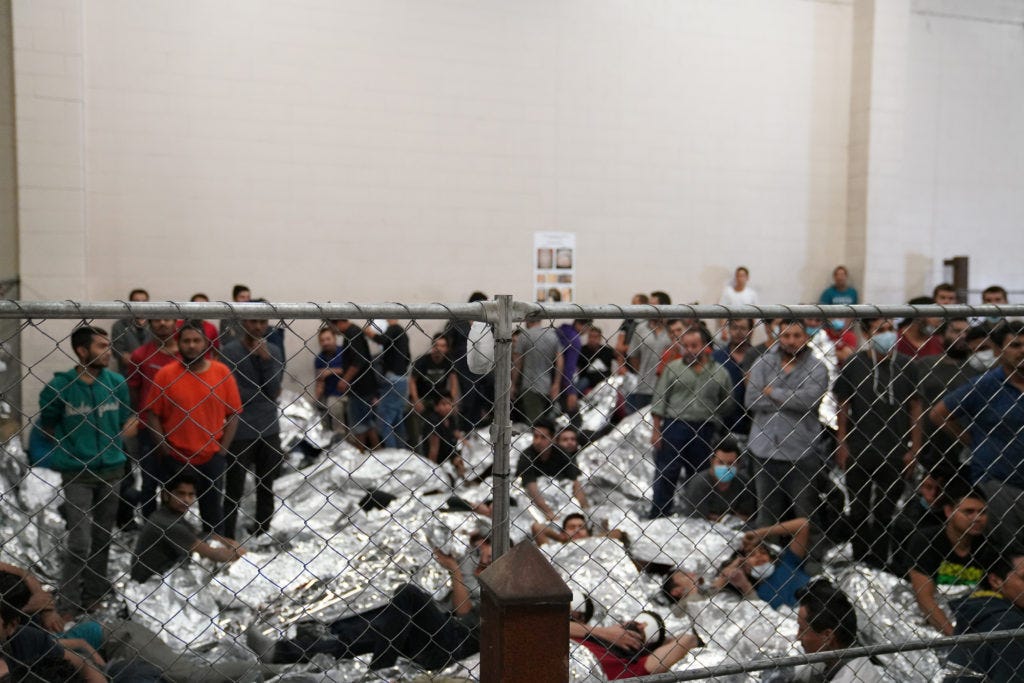
Historians define concentration camps as sites of mass civilian detention without trial, based on group identity. That definition predates Nazi Germany. It has been applied to Spanish reconcentración camps in Cuba, British camps during the Boer War, early Nazi camps in the 1930s, Japanese American internment, and the Soviet Gulag system. Extermination is not the threshold. It is what sometimes follows, after the machinery is normalized and the public learns how to look away.
By that definition, the United States qualifies.
Across the country, more than 200 facilities are currently used to detain immigrants and asylum seekers who have not been convicted of crimes. Many are held indefinitely. Many have little or no meaningful access to lawyers. Many are transferred hundreds or thousands of miles away from their families. Their confinement is not based on individual guilt but on immigration status, nationality, or executive designation. Due process exists mostly as a theory. Rights exist mostly on paper.
This didn’t suddenly start in 2025. The infrastructure was already here. It was built quietly over decades, expanded under administrations of both parties, and protected by language designed to anesthetize the public. “Detention centers.” “Processing facilities.” “Temporary holding.” Americans were encouraged to imagine something orderly and humane. What they got instead was a vast, distributed network of civilian detention sites built to manage populations, not adjudicate justice.
What did change in 2025 was the legal environment surrounding those camps.
Wartime-style executive authority was invoked to push detention even further away from courts and deeper into the hands of the executive. Habeas corpus was not formally suspended, but it was functionally weakened for targeted groups. Judicial review narrowed. Group identity mattered more than individual circumstances. Detention became easier to justify, harder to challenge, and longer to escape.
In theory, detainees retain legal rights. In practice, those rights are unreachable. When detention decisions are executive, review is limited, access to counsel is remote, and confinement is indefinite, rights become decorative. History does not recognize decorative rights as protections.
And now the system is preparing to scale.
Reporting and internal planning documents show that U.S. Immigration and Customs Enforcement has explored plans to convert large industrial warehouses into mass detention hubs capable of holding thousands of people at a time. A “hub-and-spoke” model. Funnel people from smaller facilities into centralized mega-sites optimized for volume, speed, and control. Warehouses. Buildings designed for inventory. Retrofitted not for dignity or due process, but for efficiency.
That language isn’t accidental. It’s the system telling the truth about itself.
Warehouses are cheaper. Warehouses are easier to secure. Warehouses are easier to hide. They are disastrous for access to legal counsel, medical care, and oversight. Lawyers cannot meaningfully represent clients scattered inside cavernous facilities hours from courts. Judges cannot plausibly claim individualized review at that scale. “Temporary” becomes indefinite by design. What remains is management, not justice.
Historically, this moment matters. Concentration camp systems do not begin with mass killing. They begin with consolidation. With centralization. With the conversion of human beings into units to be stored, processed, and moved along. Warehousing is not a metaphor critics invented. It is the next logical step of a system already built.
The United States is not at the end of this story. That distinction matters. But it is no longer at the beginning either. More than 200 sites of mass civilian detention already exist. The move toward industrial-scale warehousing does not replace that system. It refines it.
People recoil from the phrase “concentration camp” because it carries moral weight. That discomfort is the point. Arguments over language exist to delay responsibility, not to clarify reality. History doesn’t care what governments call their facilities. It records who was confined, how, and why.
Two hundred plus concentration camps.
Operating. Funded. Defended. Expanding.
In the United States. In 2025.
History does not ask whether the language was polite. It asks whether people were confined without trial, whether courts were sidelined, and whether the public looked away. By those measures, the United States crossed a line before most people were willing to name it.
Support Closer to the Edge to keep reporting like this independent, unsanitized, and very hard to bury.
This post has been syndicated from CLOSER TO THE EDGE, where it was published under this address.