
I had a plan: I was going to send out a short note this morning with a short film that was going to help explain my absence over the past couple of weeks (four events on three continents) and a huge message of thanks to everyone reading this who’s been supporting my work for the last year.
It was going to partly be a holding note, noting how the post-war global order has profoundly shifted in the last two weeks and how I plan to cover it and try – with you – to make sense of that in the coming weeks.
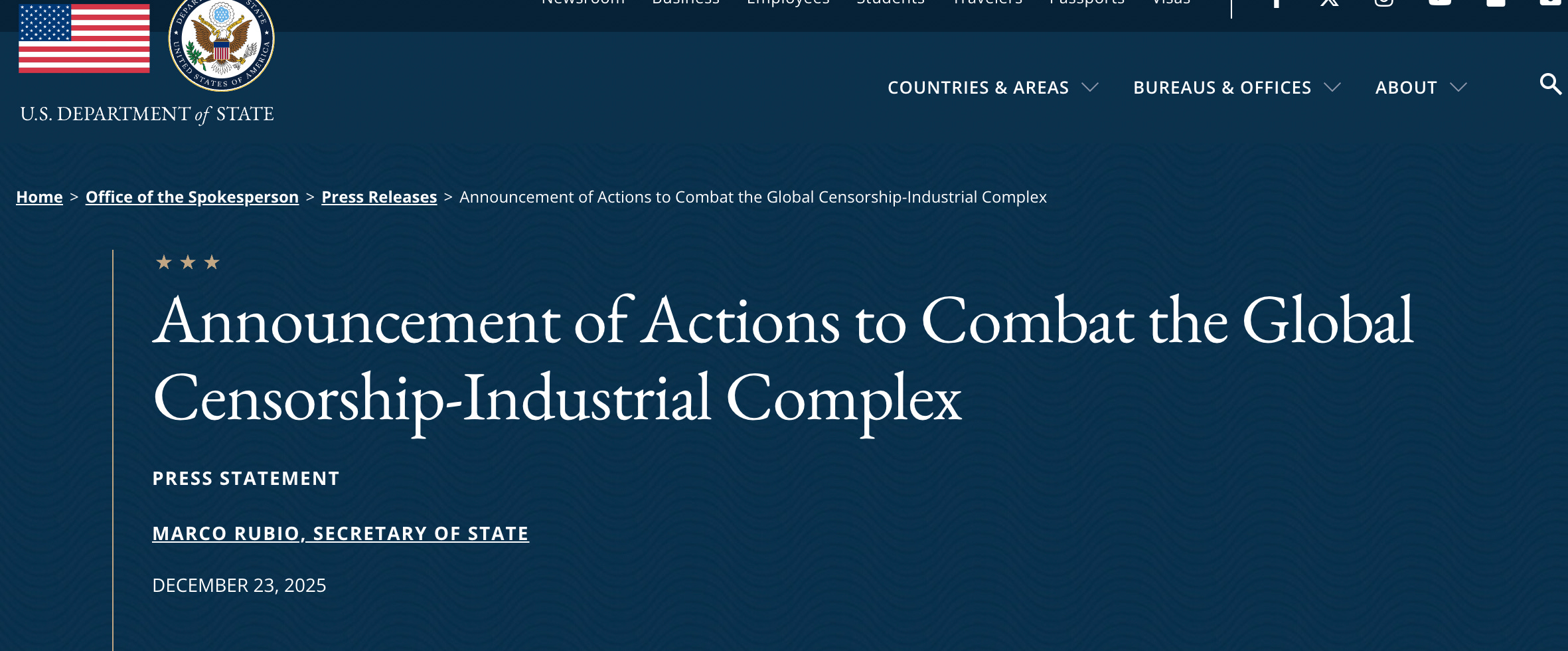
But fascism never sleeps. And last night – after European offices had closed for the holidays – the US state department announced “Actions to Combat the Global Censorship-Industrial Complex” and that it would be barring five individuals from the United States.
The so-called “global censorship-industrial complex” is a tiny world of academics and NGOs and journalists and policy wonks and lawmakers and disinformation researchers who for the last decade have been trying to understand the power and reach of the tech platforms, how they are invisibly controlling and manipulating our information spaces.
I first heard the term from a friend at a US university after she found herself described as such on a target list back in the summer of 2022. We had a good old laugh about it and have used it ironically ever since.
But the news last night was chilling.
The order states:
“The State Department is taking decisive action against five individuals who have led organized efforts to coerce American platforms to censor, demonetize, and suppress American viewpoints they oppose. These radical activists and weaponized NGOs have advanced censorship crackdowns by foreign states—in each case targeting American speakers and American companies. As such, I have determined that their entry, presence, or activities in the United States have potentially serious adverse foreign policy consequences for the United States.”
These “radical activists and weaponized NGOs” are my friends and colleagues and fellow fighters in the information trenches and this is a dramatic escalation. It’s Russia-level repression. It’s an all-out attack on civil society. And it’s specifically going after European efforts to legislate the social media giants for users in Europe. We are now the enemy.
Russia introduced a “foreign agent” law in 2012 to target NGOs and it was also one of the first escalations after the invasion of Ukraine when it labelled news organisations as such and made it impossible to continue reporting inside the country. This is where this leads. This is the same accusation couched in the same language.
The target here is a small group of researchers and policymakers who have understood the threat these platforms pose and have been doing the thankless and frustrating task of trying every possible route to work out how to hold them to account. And this order is perhaps the clearest signal yet of how the US government and Silicon Valley are one and the same and European liberal democracies are now the enemy.
That was what was revealed in the extraordinary National Secuity Strategy paper the US government published a week or so ago. Russia and China are no longer a threat to US national security interests. The enemy now is European democratically elected governments, especially those who seek to rein in Silicon Valley companies. And this is what this now looks like.
I was out last night, when the news broke and messages started pinging into the Signal group of the small NGO I set up in 2020, the Citizens, focussed on exactly these issues. We too are members of the “Global Censorship Industrial Complex”.
Initially, it wasn’t clear who the five individuals were and it could have been any of the many members of that group. But then, it was revealed. One of them – whom I know – is Imran Ahmed, a Brit living in the States and who, according to the order, will now be deported. He’s CEO of an organisation called Center for Countering Digital Hate and if you’ve heard of him – and this is a tell – it’s because he’s previously been targeted by Elon Musk, who’s sued him.
And another is Thierry Breton, a high-profile former member of the European Commission who was instrumental in the Digital Services Act, a piece of groundbreaking legislation that has real heft and that the Silicon Valley tech companies – and now their proxy, the US government – hate.
But perhaps, most chilling of all on a personal level, reading this news in London was how the US government chose to communicate this news. It was the under secretary of state, Sarah B Rogers, who released the names and she did so via the UK’s far-right GB News channel:
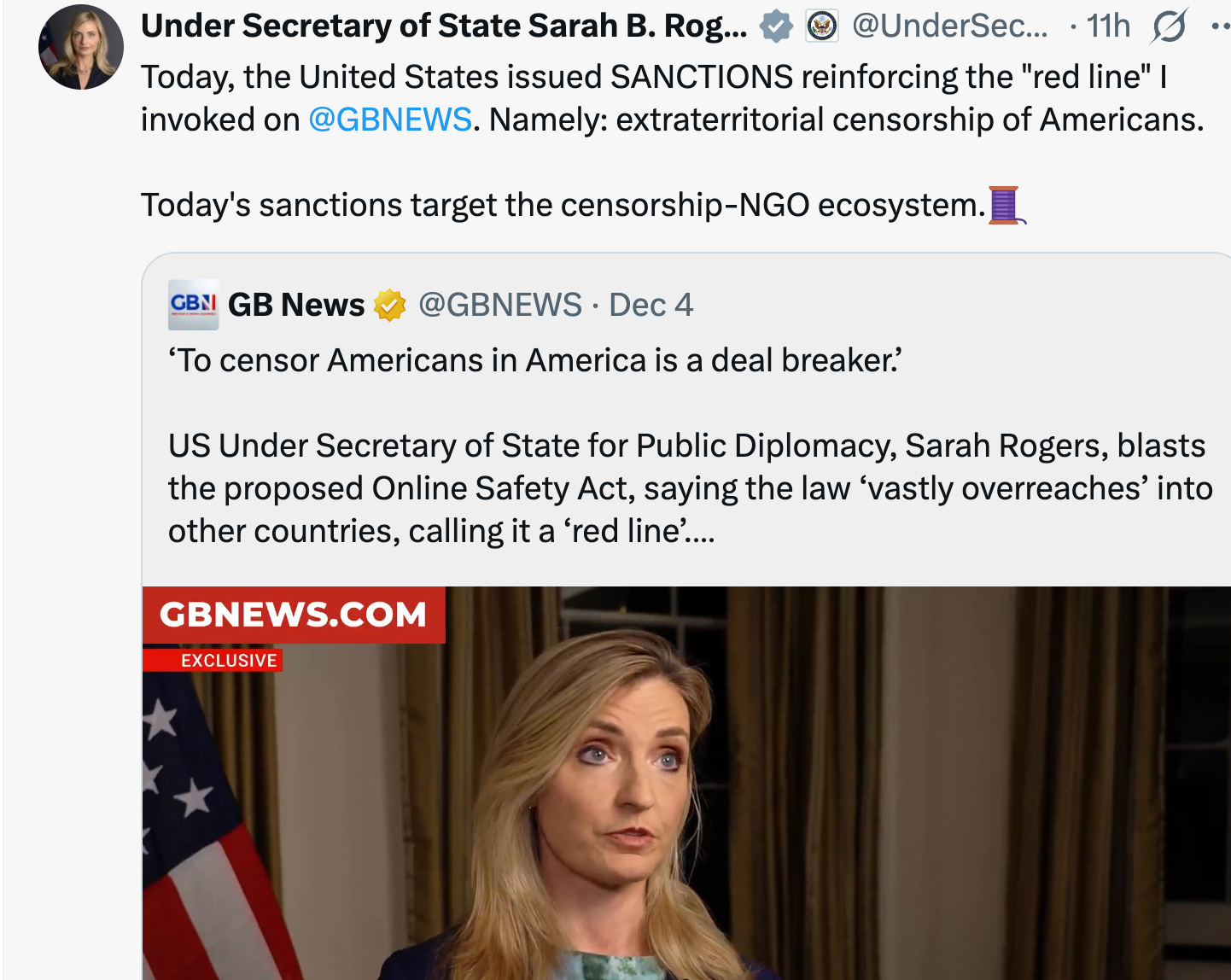
In the UK, we have legislation which means that it shouldn’t be possible to own and run a “far-right UK news channel”. But there you go. Rules and regulations only work if you enforce them and in GB News’s case, they’re not. And what this highlights and what hardly anyone in a position of any power in Britain seems to understand is how tightly bound up we are in the US’s technofascist plunge.
Because that’s what this is. I’ve mostly used the word technoauthoritarian rather than technofascism but the other thing I did last night after returning from a jolly Christmas celebration was to watch the banned 60 Minutes programme that was pulled off the air on Sunday night on the orders of Bari Weiss, the far-right founder of the Free Press who’s been parachuted in to run one of America’s most storied newsrooms.
If you’ve missed this story, the US investigative journalist programme, 60 Minutes, had completed a report on El Salvador’s notorious CECOT prison where the US deported hundreds of untried Venezuelans on the flimsiest of pretexts. Weiss pulled it claiming it “needed additional reporting” and would “air in a future broadcast”.
What Weiss hadn’t realised was that the film was already available via CBS’s international partners and it’s now been ripped and shared online. You can watch it here, for eg.
I wrote about the prison earlier this year because it was emblematic of something profoundly disturbing. The Instagram images of Kristi Noem, the US Secretary of Homeland Security, touring the prison didn’t just showcase its cruelty and depravity, this was was cruelty and depravity designed to be liked and algorithmically shared: a a concentration camp designed for social media.
Compared to some of the footage and reports I watched at the time, the 60 Minutes film is relatively tame and restrained. It includes interviews with a former prisoner, sent there by the US government, and human rights researchers who have documented how the treatment of the prisoners, in their analysis, amounts to torture.
All credit to the correspondent, Sharyn Alfonsi, who spoke up to defend her work. It had been screened five times, she said, for CBS’s lawyers and editorial policy team and cleared for broadcast.
“It is factually correct. In my view, pulling it now, after every rigorous internal check has been met, is not an editorial decision, it is a political one.”
Which brings me, finally, to where I wanted to start. We have to keep reporting on what is happening in the world. We have to keep trying to track it and explain it. And we have to find new, creative ways to do independent journalism, to reach audiences, to convey the profound threats we are facing. And, always, to speak up, as Sharyn Alfonsi shows us, when necessary.
This is not politics as normal. And we can’t treat any of it as politics as normal.
I set up this newsletter after Trump’s re-election last November and as my own news organisation, the Guardian, was going through its own internal revolt. It had chosen to sell off part of it – the Observer, the oldest Sunday newspaper in the world – and get rid of 100+ journalists.
In the end it didn’t even sell it, it gave it away plus £5m in cash. But, the fact that just nine months on, with no external investment, a group of five of us – three editors, the creative director and me – have managed to set up a tiny new grassroots media outlet is nothing short of a Christmas miracle.
I made my first reel to celebrate. It’s a cheerful watch, I promise, and it’s only been possible to do it because of the support I’ve had here. THANK YOU. THANK YOU. THANK YOU. Grassroots, community-based efforts are, I believe, the best defence against what feels like an engulfing darkness. And that includes the media. Just look at CBS.
But we also have to have international networks of solidarity and last night’s news highlights that more than ever. If you are reading this is in America, we are not your enemy. We are your friends and allies now more than ever, Carole xxx
A note on what I’m doing and why. I’m an investigative journalist who worked for the Guardian for 20 years latterly investigating the intersection of politics and technology that included 2018’s exposé of the Cambridge Analytica/Facebook scandal. The opaque and unaccountable Silicon Valley companies that facilitated both Brexit and Trump are now key players in an accelerating global axis of autocracy. I believe this is a new form and type of power that I’m committed to keep on exposing: Broligarchy.
This post has been syndicated from How to Survive the Broligarchy, where it was published under this address.