
Just before being put on board her deportation flight, Melissa Tran’s wrists and ankles were shackled to a chain around her waist. It had been more than 10 hours since she’d been given any food or water; for the last seven she had been sitting on a bus on the tarmac.
There was no company name or logo on the Boeing 767, but she soon learned the airline was called Omni Air International. She’d never heard of it, nor of Stonepeak, the private equity firm that purchased Omni in April 2025, nor of its billionaire CEO, who was an immigrant himself. She had no idea that Omni’s ICE work had quadrupled since the sale, or that its flights were getting longer and, because of that, crueler.
There were 10 female deportees clustered in coach, with about 180 men seated behind. Tran noted a variety of accents and ethnicities, and wondered how many stops were planned and how long she’d be shackled. When an ICE-contracted guard walked by, she asked about their flight time.
“Where are you from?” he responded. Vietnam, she said—though she hadn’t been there since her family fled when she was 10. The Maryland mother of four had long put a 2001 theft conviction behind her, becoming a health care worker and small-business owner, but at an ICE check-in three days earlier, she was arrested and flown to detention in Alexandria, Louisiana.
The guard winced: “Sorry, you’re the last stop.” He told her she wouldn’t arrive in Hanoi until Thursday. It was Monday night in Louisiana.
Stonepeak, which manages $80 billion in investor funds, specializes in recession-resistant infrastructure investments—utility companies, airports, toll roads, shipping and logistics firms. Forbes estimates its Australian-born co-founder, Michael Dorrell, is worth $8.5 billion, a fortune made through his “bet on boring,” as one podcast interviewer recently put it.
“It matches my personality,” Dorrell jokingly agreed. The 52-year-old’s one public extravagance appears to be real estate, purchasing a $34 million waterfront mansion in Coral Gables, Florida, a $41 million Manhattan townhouse from David Koch’s widow, and a $150 million private island paradise in Palm Beach, less than two miles from Mar-a-Lago, all in the last few years.
Information about Stonepeak’s acquisition of Air Transport Services Group, Omni’s parent company, is scarce, comprising just two press releases: one from the day before the 2024 election announcing a $3.1 billion all-cash sale, and another five months later announcing its conclusion.
Both emphasized ATSG’s subsidiaries in cargo transport (including planes leased to Amazon), ground services, aircraft leasing, and maintenance, with only passing mention of its charter airline, Omni, described as “a leading supplemental provider of passenger transport for the US Department of Defense and other agencies.” Nowhere do they say that for years, Omni has been the only large-jet airline flying shackled passengers on long-haul ICE flights to Africa and Asia.
Like Dorrell, Omni has a knack for staying under the radar, even as it profits from Trump’s migrant crackdown; Omni, ATSG, and Stonepeak did not respond to detailed questions. But since the sale, Omni has flown thousands of deportees delivered to its planes by ICE.
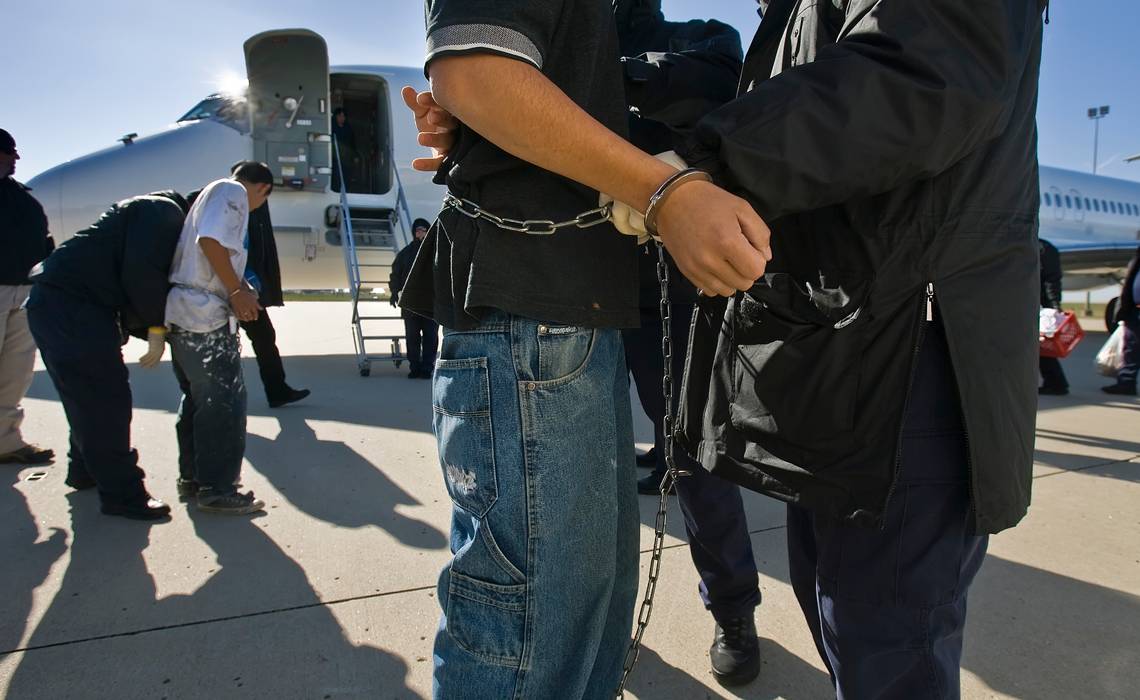
Last May, Omni transported migrants whom ICE had expelled to Panama months earlier to their countries of origin in Africa and Asia, despite many having valid asylum claims and credible fears of what could happen after returning. It took dozens of Russians to Egypt in August and December, where they were forced on planes to Moscow. At least one antiwar dissident was taken by Russian authorities upon arrival, according to witnesses, and is now missing.
Since September, Omni has transported more than 47 migrants to Ghana, a country where they had no ties. At least some—perhaps all—had US court orders barring deportation to their countries of origin, including a 21-year-old survivor of female genital mutilation and a grandmother from Sierra Leone who had been in the United States for three decades. Ghana’s government forced many to return to their home countries anyway, or to cross the border into Togo without identification, rendering them effectively stateless.
“You don’t have to torture people. They’re not going anywhere—they’re on a plane.”
Omni transported about 100 Iranian asylum seekers to Qatar in September and Kuwait in December, where they were put on Tehran-bound planes. One passenger told the New York Times he was so afraid of going back he attempted suicide the day of his flight.
On October 24, Omni flew an Alabama father to Laos who was expelled by ICE despite a court order barring removal because he had a valid claim to US citizenship. On November 17, the airline transported 50 Ukrainians to Poland who were then taken to Ukraine, despite domestic and international law prohibiting repatriation to war zones.
These stories are likely the tip of the iceberg. In the eight months following Stonepeak’s acquisition, public flight data suggests Omni carried out 77 trips under ICE subcontracts, making 194 stops in 42 countries, including authoritarian regimes like Cambodia, Cameroon, China, Cuba, the Democratic Republic of Congo, Laos, Uzbekistan, Venezuela, and Vietnam. Over the same period in 2024, records suggest Omni flew only 20 ICE trips to just 14 countries.
It is unclear how much the nearly fourfold jump is based on changing corporate strategy and how much is just increased demand. Overall, ICE removal flights began climbing last April and are up 41 percent under Trump, according to Human Rights First.
But beyond facilitating potential human rights abuses, Omni’s flights themselves are becoming increasingly inhumane. In 2024, only six trips lasted more than 24 hours, with the longest lasting 38 hours. But of the 77 trips carried out between Stonepeak’s mid-April purchase and the end of 2025, 31 lasted between 24 and 50 hours before the final stop. Migrants onboard until then would have spent all that time, and likely more, shackled. A man deported to Laos in October told me he was shackled for 73 hours after his Omni plane unexpectedly returned to Louisiana, which flight data confirms. He and nearly 200 others were kept restrained overnight before a second takeoff; at least 20 elderly deportees were so weak from sleeping on the floor that they needed to be pushed across the tarmac in wheelchairs and carried to their airplane seats, he said.
Flight data shows an Omni ICE flight out of El Paso made a similar return in December before restarting its deportation journey. An immigration attorney told me a Vietnamese client onboard was shackled for more than 80 hours.
Shackling people for long periods “is dangerous on so many different levels,” said Judy Melinek, a forensic pathologist whose research backed a congressional enquiry about the safety of detained migrants. It is painful and can cause swelling, bruising, cuts, and permanent nerve damage. Shackled passengers are at a “very high” risk of developing blood clots in their legs that can be deadly if they travel to the heart or lungs, Melinek said, because ICE’s guards control when, and if, they can drink water or move around.
Migrants have also said they sometimes soil themselves in their seats. Even when permitted to use the lavatory, many say it is difficult to adequately clean themselves while shackled. Migrants on Omni flights to Africa have reported verbal and physical abuse by ICE agents and guards, and being put in straitjacket-like devices and hoods for minor infractions.
“You don’t have to torture people,” Melinek said. “They’re not going anywhere—they’re on a plane.”

ICE and the Department of Homeland Security did not answer detailed questions, including whether they track injuries or deaths caused by their practices on deportation flights. DHS spokesperson Tricia McLaughlin insisted shackling is “in line with established legal standards” and “an essential measure to ensure the safety and well-being of both detainees and the officers/agents accompanying them.”
It’s hard to know how much Stonepeak makes off this misery, especially now that ATSG is privately held and no longer releases earnings reports. A 2023 pricing sheet from ICE’s flight broker lists the aircraft in Omni’s fleet as costing at least $20,475 per flight hour, plus expenses. This does not appear to include a “special high risk” fee added to Omni’s African and Asian flights.
An ICE document obtained by Quartz shows the agency paid Omni $33,500 an hour for a 2019 flight to Bangladesh, India, and Vietnam. With expenses, the trip cost $1.8 million, prompting a flight broker to complain Omni could charge high prices because other airlines “are discouraged by the potential of public backlash.”
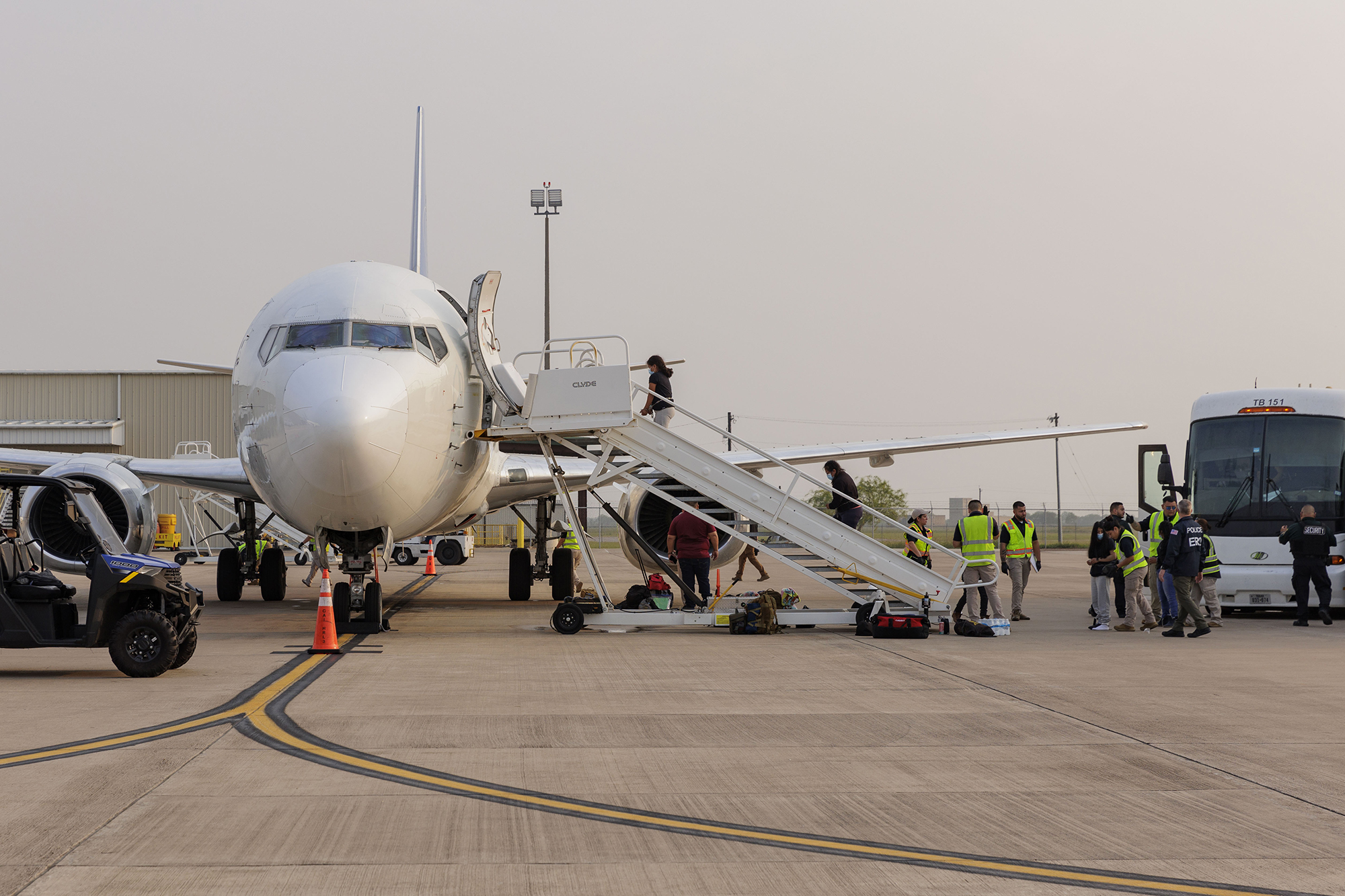
Omni’s sale to private equity might appear to have insulated it from public pressure, but according to Pitchbook, a private market data broker, most Stonepeak investors are nonprofits and public pension funds, including many based in blue states. A representative for one of the largest, the New York State Common Retirement Fund, said it had not been aware of Omni’s role in deportation flights but had “contacted Stonepeak to seek additional information and understand how these serious issues are being addressed.”
Melissa Tran was shackled on her Omni flight for 42 hours, during which she said her wrists became “dented” and red. While stopped in Romania, India, and Nepal, guards allowed passengers to stand and stretch—one row at a time, one minute per row.
“My body was aching,” she said, adding that she never slept, because “every time I closed my eyes, I thought about my children” and would sob. She only glimpsed an Omni flight attendant once, up in first class, serving guards and ICE agents, who were mostly indifferent—though the guard who spoke to her about the flight said he would pray for her.
Still, she said, “I felt like I was less than an animal.”
This post has been syndicated from Mother Jones, where it was published under this address.