
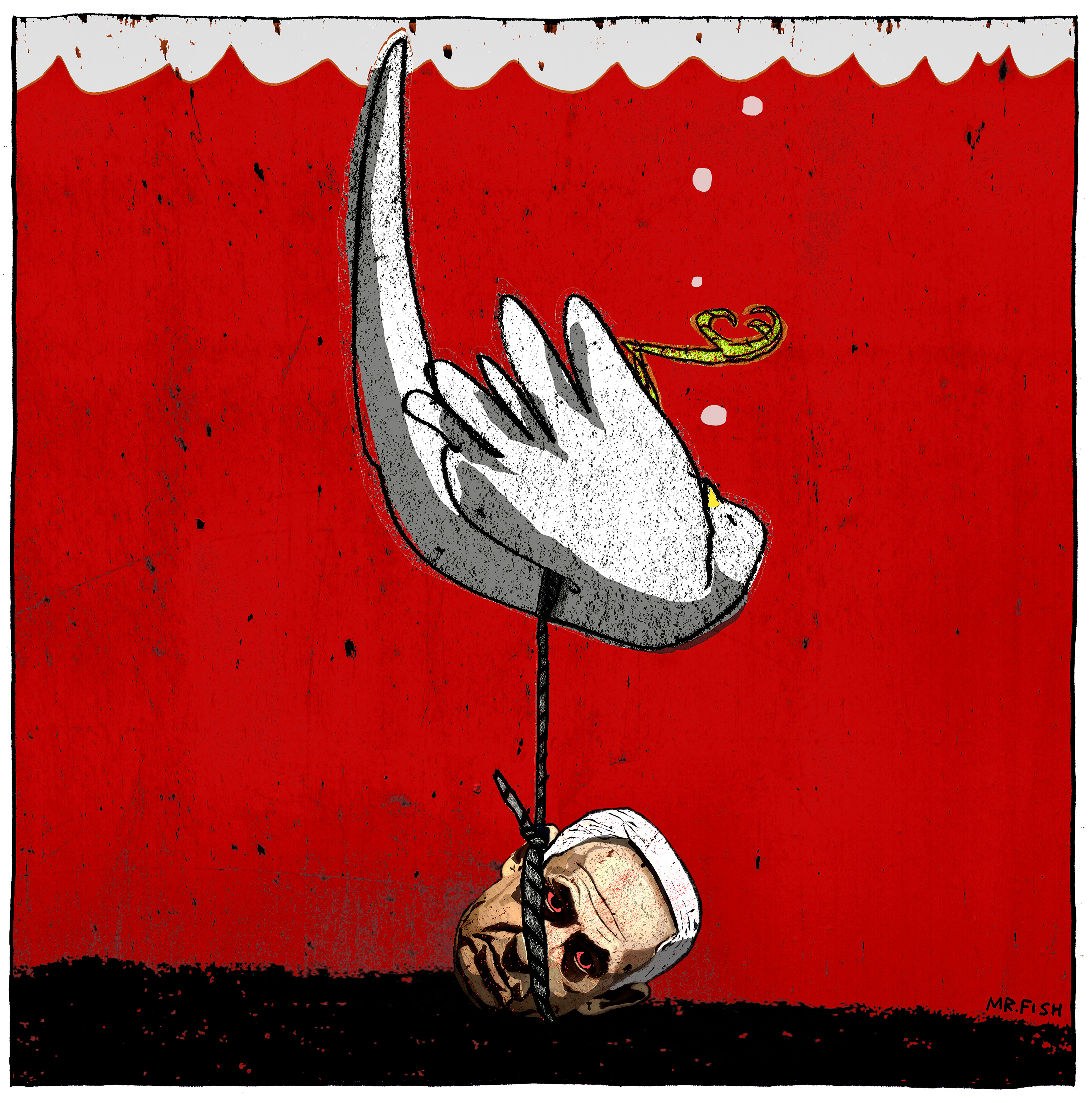
Sea Monster – by Mr. Fish
ROME, Italy — There will be a new flotilla in April 2026 that will attempt to break the 18-year-old Israeli blockade of Gaza. The mission is expected to be the largest maritime action for Palestine to date, involving more than 3,000 activists from 100 countries on 100 boats, including a medical fleet of 1,000 health care workers to deliver 500 tons of life-saving aid, equipment and medical supplies that Israel has blocked from entering Gaza.
Once again, activists from all over the world will sail toward Gaza in an attempt to end one of the worst humanitarian crises on the planet. Once again, their journey will be minutely tracked on social media. Once again, Israeli drones will be sent out in international waters to intercept and attack the boats. Once again, the boats will be boarded by masked, heavily armed Israeli soldiers. Once again, activists will be arrested. Once again, they will be sent to high-security prisons. Once again, they will be physically abused, placed in solitary confinement, insulted, berated, forced to watch Israeli propaganda videos about Oct. 7, or raped by Israeli prison guards. Once again, Palestinians, many of whom wait on the beach in the hope that the latest flotilla will get through, will see they are not alone. And once again, the world will look away, ignoring its legal mandate to intervene to end the genocide, as per Article I of the Genocide Convention.
And yet, despite the almost certain outcome, the flotillas are imperceptibly chipping away at the Israeli stranglehold on Gaza. They are reminding the world of its moral and legal duty to intervene. They are shaming not only Israel, but the Western governments whose complicity sustains the genocide. They are illustrating that we are not powerless. We can act.
“How did you feel when you watched the flotilla?” I asked the Palestine ambassador to Italy, Mona Abuamara, when I joined the Italian dock workers strike in Genoa and national demonstration for Palestine in Rome at the end of November 2025.
“Like a child,” she answered. “You know how when you know the end of a movie but you still want it to be different. I kept thinking, ‘Let it pass. Let it pass.’ As if it could. We knew it wouldn’t. That’s part of the beauty of those people on those boats. They knew they’re not going to be allowed to pass, but they refused to accept the status quo.”
I met Thiago Ávila, a Brazilian activist, and Swedish activist Greta Thunberg early in the morning at the MAAM Museum in Rome, its labyrinth of halls, corridors and rooms filled with street art, including a sign that reads, “Spoiler YOU WILL DIE.” Some 200 migrants from various countries live as squatters in the abandoned slaughterhouse and museum. Artworks, including huge, elaborate murals by some of Italy’s best artists, cover the cement walls of the former meat factory. At the entrance, satirizing the Hollywood sign in Los Angeles, in huge letters, is the word “FART.”
“For all the years I’ve been an activist, I have, every day, lost more and more hope — if I even had any — in the institutions and our so-called leaders, corporations, elected officials, banks, whatever it is, to come to our rescue,” Thunberg said. “They are the ones who have put us in this situation. The system is not flawed. It is designed to be destructive. It is designed, in my view, to have unequal power structures. It is designed to keep some people oppressed. It is designed to keep nature as a distant, separate entity that is not a part of us in order to exploit it. In order to oppress people, we have to dehumanize them. The only way out is to reclaim power, which is one of the main reasons why I’m here supporting the striking workers in Italy. This is such a clear, textbook example of what it looks like when people take back power and show where the real power is.”
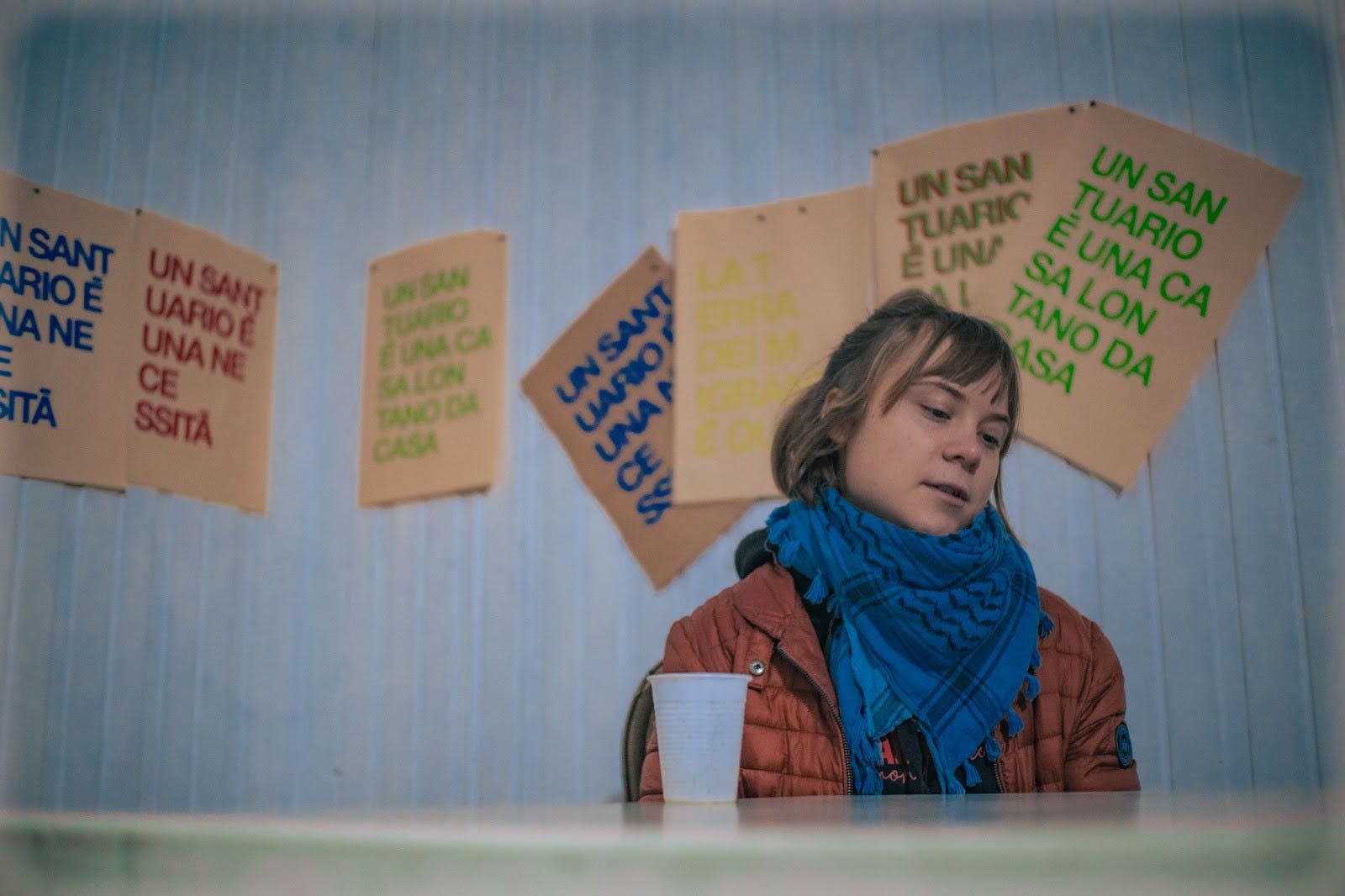
Greta Thunberg during my interview at the MAAM Museum (photo by Thomas Hedges)
Ávila organized the Freedom Flotilla Coalition and the newly formed Global Sumud Flotilla. He was part of the crew of the Madleen, a boat that departed in June 2025 with, among others, Thunberg and Rima Hassan, a French-Palestinian Member of the European Parliament who was beaten in custody by Israeli prison guards.
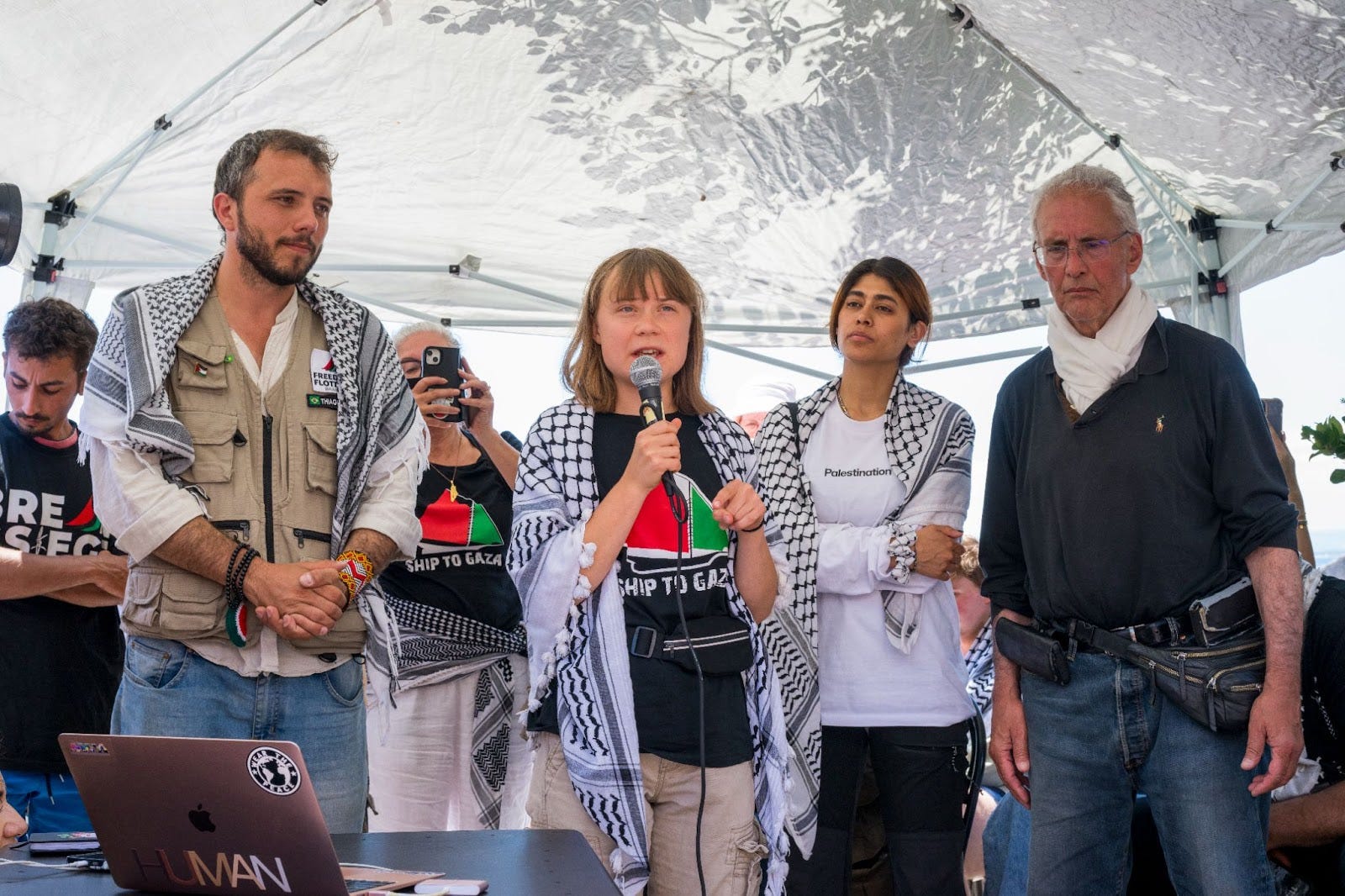
Thunberg (M), Ávila (L), Hassan (R) and others aboard the Madleen on June 01, 2025 in Catania, Italy. (Photo by Fabrizio Villa/Getty Images)
The Madleen was intercepted by the Israeli navy in international waters and towed to the Israeli port of Ashdod. Ávila was held in solitary confinement in Ayalon Prison, where he took part in a dry hunger strike until he was deported.
“I’ve been on so many failed attempts I can’t count,” Ávila told me. “I’ve been in boats that were unfortunately bombed. I’ve been in boats that were sabotaged. Boats that were defeated bureaucratically by countries pressured by Israel. We’ve been trying for years to break that horrific siege. Eighteen years. The last two attempts I was with Greta. I made it close to Gaza twice.”
While in prison, he said, Israeli guards kicked him and slammed his head onto the asphalt. They interrogated him for hours in an attempt to extract details about the flotillas while a guard pointed a shotgun at him. They sent snarling guard dogs into his cell. They constantly moved him from one cell to another. They woke him up repeatedly during the night.
“How many countries have you managed to mobilize?” Israeli interrogators asked Ávila.
“Who are the representatives in the countries?” they demanded to know.
“I’m not going to give you any information that would put anybody into a dangerous position,” Ávila answered. “But anything that is public, you can check on our website. We are very transparent.”
“Look, what you make your people go through,” the interrogators sneered. “Look at all the money that you spent, that you wasted. Think of what you could have done with this money?”
“Why are you doing this?” the army interrogators, intelligence agents and Israeli judges invariably asked.
“Because for eight decades you have been committing genocide and ethnic cleansing,” Ávila always answered. “You have structured an apartheid and colonial state. You are ruling this land, not by a religion, but by a racist and supremacist ideology, which is Zionism.”
“What’s their reaction?” I asked Ávila.
“They hate it,” he said.
“Most of the Israeli government wanted us out of there as soon as they could the last time we were held,” Ávila said. “It was a horrible PR situation. But Itamar Ben-Gvir, the Minister of National Security — who manages the Israeli prison system — didn’t want to let us out. He wanted to punish us. He wanted to make a political statement. There was this internal struggle. Eventually they tried to get rid of people.”
“International solidarity has the responsibility to be more useful to the Palestinian cause,” Ávila said. “We need to have a bigger impact. This time, we managed. When we went with the Madleen, we had been trying for the previous five months. We tried three other missions that failed. And to be honest, the world barely knew about them.”
On one of the failed missions, shortly after midnight on May 1, 2025, 20 miles off the coast of Malta, one of the flotilla’s boats — the Conscience, registered under the flag of Palau — was struck by missiles launched from two drones. The missiles appeared to target the ship’s generators. The strikes caused a fire and a breach in the hull. Communication with the ship was lost. It was loaded with humanitarian supplies.
“The European Union didn’t condemn the attack,” Ávila said of the strike. “It was a hard defeat for us. But we knew we had to keep trying. We didn’t have any more big boats. All we had was a small boat for 12 people. It could only carry a symbolic shipment of aid. But that is when the world paid attention. There was a huge mobilization to support us.”
There is always the possibility the Israeli assaults will turn deadly.
In May 2010, the Mavi Marmara, carrying activists and humanitarian aid, was raided by Israeli naval commandos in international waters as it sailed toward Gaza. Nine people — eight Turkish citizens and one with dual Turkish American citizenship — were killed by the Israelis who claimed they were attacked by activists armed with clubs and knives. Another 24 were seriously injured by live ammunition fired by Israeli forces.
“I’m 39 years old and I’ve been dedicated to social struggles as an internationalist for 21 years,” Ávila said. “And Palestine was always part of that. I’ve been to Palestine before. Palestine is the most important cause of our generation. It symbolizes everything — the struggle against exploitation, oppression, destruction of nature. The same system that enables a genocide in Palestine carries out genocides in the Sudan and the Congo. It is the same system that carries out an ecocide in Brazil and against the biomes on this planet. If we can defeat imperialism and Zionism in Palestine, we can defeat it anywhere.”
At 9 p.m. on the night before we spoke, Ávila was in his hotel room when he heard a knock on his door.
“I thought it was Greta bringing me food,” he said. “It was the police. They were not violent. They’ve been worse with me here before. They entered. They searched the room, the closets, everything. They started asking about my plans. They were not very concerned about the strike or the mobilization. They wanted to know about flotillas. They wanted to know about boats. Whenever I’m in Italy, the police and security service, all they keep asking is, ‘Are there boats coming here? Are there boats coming here?’ We don’t have an ongoing mission right now. I guess they understood that. We are on the eve of a big demonstration in Italy, so it’s also a way for them to try to intimidate, to show their presence, because, to be very frank, they know how transparent we are. We always make our missions public. If we had a mission, they would know. They didn’t need to show up in my room in the middle of the night.”
“Whenever we are in the context of anticolonial and anti-imperialist struggles, the final victory is not a click of the button,” Ávila continued. “It’s a process. We never know when the system will collapse. When it does, we will not be intercepted. We need to be the ones that keep on coming until Zionism does not exist, then we will be able to pass. Or at least when it’s weak enough and we are able to pass. Then we will understand it’s gone. We need to keep on going until the day when the political cost for them to intercept us is too high for them to pay and they need to stay out of our way.”
I asked him if he has political heroes.
“I come from a Marxist education,” Ávila said. “We have a lot to benefit from the history of revolutions. Definitely Che Guevara. Rosa Luxemburg. Marx. Engels. We are here in Italy, so Antonio Gramsci. We have a lot of beautiful people in anticolonial struggles. Thomas Sankara. Frantz Fanon. Nelson Mandela. We have people who led nonviolent direct action — beautifully inspiring things. Mahatma Gandhi. Martin Luther King Jr. Rosa Parks. These are many references. These are tools. They save us time. We do not have to make their mistakes. They carried a banner and passed it on. If we do not receive this banner, full of experiences, it’s a complete mistake. We can’t be lazy. We need to study.”
Dock workers in Italy threatened Israel with a total block on trade if they harmed the 462 activists, parliamentarians and lawyers on the 42 vessels attempting to breach Israel’s blockade. When Thunberg learned of this act of solidarity by the dock workers while on the flotilla, she broke down in tears.
Israel intercepted all the boats and arrested every crew member. Most of the activists were held at Ktzi’ot Prison, also known as Ansar III, a high-security detention facility in the Negev Desert used to detain Palestinians, many of whom Israel accuses of involvement in militant or terrorist activities. They were crammed into cells with often a dozen or more people and slept on mattresses on the floor.
I sat at a small table with Thunberg in the former meat factory. We were bundled in our winter jackets.
Thunberg was a special target for Israeli prison guards, who beat her, dragged her by her hair and photographed her wrapped in an Israeli flag in an attempt to humiliate her. She was kept in a cell filled with bedbugs and denied sufficient food and water.
I asked her if the time has come — as the co-founder of Extinction Rebellion Roger Hallam has said — to accept greater risks, including long prison terms. Hallam was sentenced to five years in a British prison for his role in organizing the shutting down of the M25 motorway around London.
“The personal costs are different for everyone,” Thunberg said. “For some people, going out on the street with a sign, they risk their lives. I do not. I’m forced to face repression by being slandered in the media and in the worst case, ending up in prison, where I, as a white, Swedish person, do not face the worst. So, we all have to take our personal risks into account in terms of making personal sacrifices, but it is different for everyone. But, I definitely believe we have to step out of our comfort zones and accept sacrifices and recognize all of these countless people who have made priceless sacrifices up to this date. Because if they hadn’t done that, the situation would be far worse.”
“We saw only a glimpse of what Palestinian hostages are facing,” Thunberg added, of her time in an Israeli prison. “There are thousands of Palestinians — hundreds of whom are children — who are stuck in Israeli dungeons where they are most likely being tortured. And we are seeing more and more witnesses telling that reality. Most of us had passport privileges. We had the extreme privilege of media coverage and diplomatic ties, which they do not have.”
“The flotilla was not about us,” Thunberg said. “The flotilla was a political stance as well as a humanitarian mission, but mainly a political stance. It was yet another attempt to break the siege.”
Beatrice Lio is an Italian boat captain who skippered a 41-foot monohull sloop in the flotilla. I met her in Italy. She is raising funds for the next flotilla.
Her boat was intercepted around 120 nautical miles from Gaza an hour before dawn. The full moon had just set. She was surrounded by military boats with flashing lights. One of the Israeli boats rammed her vessel. Heavily armed soldiers, their faces covered, boarded and took control of her boat. They shouted at the nine people aboard to sit down on the deck with their hands raised. They ripped down the Palestinian flag. They ransacked the contents of the boat and destroyed the communications equipment. The activists onboard were transferred to a military boat and taken to the Israeli port of Ashdod. The boat, like all the boats in the flotilla, was seized.
“We were forced to kneel on the cement and wait to be called,” she said of her arrival in Israel. “We were strip searched. They confiscated all our belongings. They photographed our passports, our fingerprints and our faces. I think I faced a judge. I’m not really sure.”
The activists were blindfolded and handcuffed. They were transported to Ktz’iot Prison in a truck where each person was locked in a tiny, individual metal cage. It was cold, especially with everyone stripped to T-shirts. The drive took three hours. They stayed in Ktz’iot for two days before being transferred to the Hadarim Detention Center, located between Tel Aviv and Jerusalem. They were incarcerated there for five days. Some were placed in isolation cells.
“Those were the people treated most badly,” Lio said of those put in isolation. “I wasn’t one of them. Those in isolation were tortured. They were beaten with sticks. Guards would sit on their faces until their eyes turned blue. They were handcuffed so tight their skin would bleed. They denied menstrual pads to menstruating women and pills to those on medication.”
“They shouted that we were criminals,” she said. “They did not acknowledge they had kidnapped us. They said, ‘You want to come to Israel and destroy my country! You deserve this!’ They talked constantly about Oct. 7. They made us watch propaganda videos about Oct. 7.”
She and other detained activists frequently heard screaming. They assumed these were Palestinians being interrogated and tortured. They were woken up every hour or every hour and a half during the night.
“They’d bang on the door,” Lio said. “They’d play loud music. They’d flash a light in your face. They’d force you to get up and say your name. I’m a small size. They gave me extra large clothes, so it wouldn’t be easy for me to walk.”
“They looked at us as humans, criminals, but human,” she said. “But when they spoke about Palestinians, they didn’t consider them as human beings. They would say, ‘I’ve killed so many in Gaza!’ They said this with happiness and pride. There was a huge picture in the prison of Gaza destroyed. It was written next to it, ‘The new Gaza.’ They bragged about it, as if it was the most beautiful picture, and it was literally soil and rubble.”
Several of the activists went on hunger strike.
“The most heartbreaking thing was to be so close to Palestinians and at the same time not able to stop, for a second, the violence,” Lio said.
No nation, with the exception of Yemen, has made any effort to physically halt the genocide. The United States and European nations have supplied Israel with billions in weapons – the U.S. alone has provided $ 21.7 billion to Israel since Oct. 7 – to sustain the mass slaughter. These nations have criminalized those, such as members of Palestine Action, several of whom are in perilous physical conditions from a prolonged hunger strike in prison, who protest the genocide. They have shut down free speech in the media and on college campuses. They will support Israel until the final phase of the genocide – the mass deportation of the Palestinians from Gaza – is complete. It is up to us to act. If we fail, there will be no rule of law. Genocide will become another tool in the arsenal of industrial nations and the Palestinians, once again, will be betrayed.
The flotillas not only keep alive resistance, they keep alive hope.
This post has been syndicated from The Chris Hedges Report, where it was published under this address.