
This story was co-published with The 74, a nonprofit, independent news organization focused on education in America.
It was January 2022, and Rhian Allvin was in search of a space that could bring her vision to life.
The early childhood leader had just finished up her nearly decade-long tenure as CEO of the National Association for the Education of Young Children, a large, national, nonprofit that promotes high-quality early learning. She’d been steeped in early childhood policy, advocacy, and research for years. She was ready for something new, something hands-on. She wanted to start her own early care and education program.
That’s how she found herself, on that winter day, driving alongside a red-brick prison wall, past imposing watch towers, and onto the sprawling grounds that were once home to a notorious maximum-security prison at the Lorton Reformatory, a correctional complex in Lorton, Virginia.
“Because the ceiling is so tall, and the kids are so small, we wanted to bring the scale down.”
A pair of the former penitentiary’s buildings was among the first Allvin toured in her pursuit of a property that would become her flagship location. The site intrigued her—how could it not? But she walked away, at least at first.
“I said, ‘I’m already out over my skis. This isn’t a great idea,’’ Allvin recalled. “I must’ve looked at 40 or 50 other spaces in Virginia. They were all so vanilla. Office buildings. I couldn’t get it out of my mind. I took friends to see it.”
Allvin saw, in the former prison, a possibility for a second life, a rebirth. Eventually, she decided she would turn this historic site, awash in nearly a century of violence and trauma, “into a place of light and joy.”
It took over a year to prepare the space, but Allvin opened the doors to Brynmor Early Education & Preschool in October 2023, with the capacity to serve up to 152 children. Today, the shuttered correctional facility is home to a thriving, high-quality early learning program.
Inside the 15-foot-tall walls, where blood was shed and brutality unfolded, babies now sleep soundly, practice newfound motor skills, learn to communicate with gestures and words, and explore the boundaries of their bodies.
Under a roof that has overseen riots, escapes, and assaults, toddlers now sit at tiny tables for mealtime, learn to wash their hands at little sinks, and attempt to regulate their big emotions under the tutelage of patient caregivers.
On the same grounds where prisoners were once on lockdown for 23 hours a day, children now move about the courtyard freely, riding bicycles and scooters around a racetrack, letting their imaginations guide them in a mud kitchen.
To get to this point, Allvin and many others had their work cut out for them. But the program is named Brynmor — Welsh for “great hill” — for a reason. Though Allvin saw a “steep hill to climb” in transforming this site and in creating a high-quality, profitable, early care and education business, she decided to take that first step anyway.

The Lorton Reformatory comprised eight prison facilities across three campuses in the relatively small Northern Virginia community, located about 20 miles outside of Washington, DC.
The complex, which operated from 1910 to 2001 and was primarily used to incarcerate DC inmates, began as a progressive work camp and evolved to include distinct buildings for women, youth, and eventually a maximum-security penitentiary.
By the late 20th century, the Lorton Reformatory, like so many other maximum-security prisons in the United States, had become overcrowded. Violence became an everyday occurrence, according to former guards and inmates featured in Lorton: Prison of Terror, a documentary produced by former inmates and released in 2022. The facility was described as “unfit for humans” and “dusty, dirty, and dangerous.”
“I had moments where I was like, ‘Was this really a good idea?’ There were days where it felt like too much work.”
After it closed, the site was added to the National Register of Historic Places. Over subsequent years, much of the old prison complex was gutted, redeveloped, and converted into art studios, gyms, and luxury apartments.
There have been several comparable efforts to repurpose closed prison facilities across the United States over the last couple of decades, said Nicole D. Porter, senior director of advocacy at The Sentencing Project, a nonprofit organization that studies policies impacting the criminal justice system.

Though a common outcome is mixed-use developments, she has noticed a trend of these spaces being converted into education centers to serve youth—typically teenagers already involved in the criminal justice system or viewed as “at risk.”
But Porter believes Brynmor is unique; she’s not aware of any other former prison facility that hosts young children. And she pointed out the irony of a program serving early learners in a building that once housed incarcerated people, since early childhood investment has been associated with lower rates of crime in adulthood.
“The idea that a site that caused so much harm … is converted into a site of learning, of teaching young people in a healthy way and a holistic way, is very encouraging,” Porter said of Brynmor. “I would hope it serves as a point of inspiration in what could be possible at closed prisons going forward.”
By the time Allvin was touring the maximum-security unit in 2022, only a small portion of the original prison cells were intact, preserved in a separate, undeveloped building on the grounds.
The two buildings she visited—9050 and 9060 Power House Road—had already been hollowed out. The two-story-high cell blocks had been removed. There was no HVAC or plumbing, just two vast rectangular buildings.
“I got a cold, dark shell,” said Allvin, who signed a long-term lease for the buildings.
But the high ceilings and large, striking glass windows, which Allvin described as “cathedral-like,” drew her in.
“The buildings were completely empty. We had a blank slate here,” said Theresa del Ninno, principal at Maginniss + del Ninno Architects, a small, women-owned architectural firm that has done a number of adaptive reuse projects for early childhood, including Brynmor. “You don’t really think, ‘This was a maximum-security prison.’”
One might imagine a former prison as gray and drab, an eyesore. That is not the reality of the Lorton site.
“There was always talk about what’s going to happen with these beautiful, historic brick buildings,” said del Ninno. “For years we’ve seen them there, so it was exciting to get a chance to work in two of them.”
The symmetrical Brynmor buildings, at about 6,700 square feet apiece, are connected by a brick colonnade portico, with ample green space in between. Inside each two-story building, the ceilings are nearly 20 feet tall. Great big windows—100 in all—allow natural light to pour in.
These elements created design challenges and opportunities.
Natural light is an obvious advantage, the architects shared. “It’s so bright and light-filled and open,” del Ninno noted.
“I could picture a child care center being there,” said Kim Jesada, project architect, about her first impressions upon seeing the space.
But the same tall, rectangular windows that allow all that light in also created challenges. “We like to have windows down at a child’s eye level,” del Ninno explained. The bottom sills of these windows, however, sit nearly eight feet off the ground.
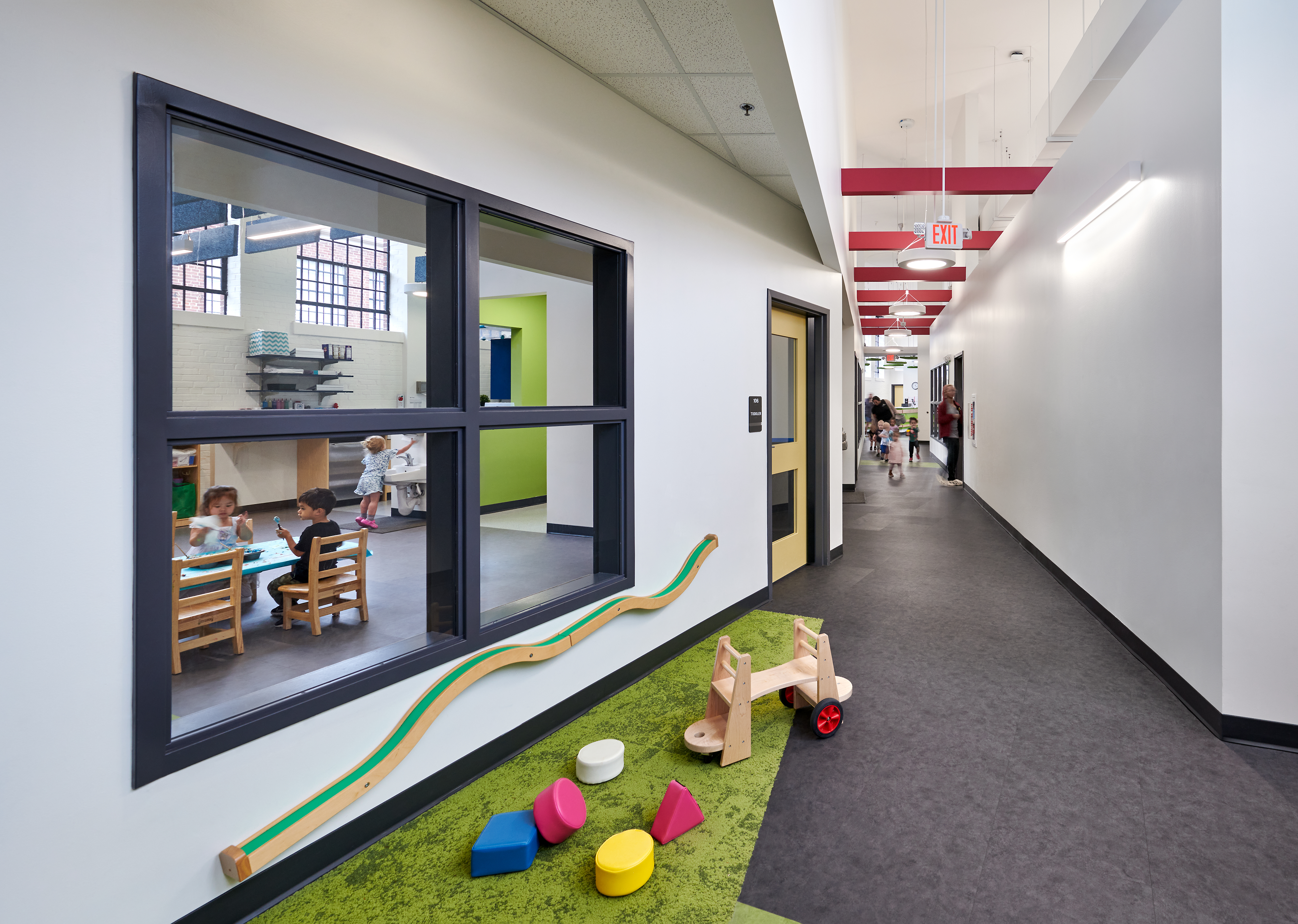
The architects made cutouts in interior classroom walls and added internal windows along the corridors to allow light from outside to penetrate the innermost parts of each building.
They also had to do something about those two-story ceilings, which are more than twice as high as a standard room.
“Because the ceiling is so tall, and the kids are so small, we wanted to bring the scale down,” del Ninno said.
They added acoustic baffles—sound-absorbing panels that hang from the ceiling—to create the feeling of a lower ceiling and smaller space without obstructing natural light.
The buildings’ shape is “very unusual,” Allvin said. That, too, was a problem to solve.
“Because the buildings are so long,” Jesada said, “we didn’t want to have one single corridor running down that feels like one endless shaft.”
Instead, the corridor charts a diagonal path through each building. That design choice resulted in what del Ninno called “non-rectilinear” classrooms—or what Allvin described as “funky-shaped.”
“I would hope it serves as a point of inspiration in what could be possible at closed prisons going forward.”
They landed on a design that had infant and toddler classrooms in one building and Pre-K in another. The buildings are connected by an open, covered walkway that overlooks a shared play area that’s almost as big as each of the buildings. It includes an outdoor storytime space, a concrete racetrack, an infant play area, and natural climbing structures with timber.
The process of transforming the buildings into the welcoming, child-friendly haven they are today was long and arduous.
“I had moments where I was like, ‘Was this really a good idea?’” Allvin recalled. “There were days when it felt like too much work.”
It was an expensive undertaking, she said. “I was building a 14,000 square-foot child care center on a family child care home budget mentality.”


She paid for the multimillion-dollar project with a combination of “socially conscious” investors, a loan from a community development financial institution and private foundation support, she said. And fortunately, there was no shortage of help.
Allvin’s own children, now grown, assembled cribs. A network she built throughout her career, including leaders of other early care and education organizations such as ZERO TO THREE and Child Care Aware of America, pitched in too, putting together furniture. But it wasn’t just friends and family who stepped up. Members of the community were moved by the transformation and wanted to be a part of it.
Shortly before the center opened, Allvin realized she needed more hands on deck, so she hired a few workers through a local company to help. One of the workers shared with Allvin that he’d grown up in DC with a very clear idea about what Lorton Reformatory represented. “He said, ‘Anytime you need help, let me know. All I knew this place to be was where people came to die. Now it’s a place where babies are born, where light happens,’” Allvin recalled. “So many people have had that reaction.”
Around two weeks before opening day, a local couple who had heard about the preschool showed up to see it for themselves, Allvin said. Both of them were former prison guards at Lorton. Allvin took them inside to see the progress, and standing in the infant classroom, the man commented that he wished society designed spaces as intentionally for incarcerated people as it does for kids, she recalled. The woman, Allvin said, returned every day for two weeks to help get the space ready to serve children and families.
When the ribbon cutting ceremony came, Jesada, one of the architects, brought her young daughter with her. She got to see the space anew through her daughter’s eyes. The girl was not privy to the buildings’ history. Her face lit up as she walked in, Jesada remembered.
“The kids aren’t coming into this space thinking, ‘I’m going to preschool in what used to be a prison,’” Jesada said. “[My daughter] saw a warm and inviting space filled with light.”
She added: “I think that with any project, seeing any of the users walk in and their reaction to the space, is what makes me want to keep designing. You see how people get to enjoy the space. Seeing this space filled with kids was my favorite part of it. They feel comfortable and safe learning.”
“He said, ‘Anytime you need help, let me know. All I knew this place to be was where people came to die. Now it’s a place where babies are born, where light happens.”
Tiara Smith, an infant teacher at Brynmor who joined a few months after the center opened, didn’t realize the program was housed in a former prison until she started the job. After seeing the still-intact cells on campus, though, she said the significance of the turnaround is not lost on her.
We’re the change,” she said. “We’re making a difference to new lives—infants, toddlers, and preschoolers. We can give them that foundation to learn to love school, and love life, and enjoy life. We can be that partnership with families. It’s definitely a powerful thing.”
Brynmor has been open for just over two years, and already it has demonstrated what so many in early care and education believe to be impossible.
From the start, Allvin was committed to serving children from all socioeconomic backgrounds. Drawing from her experience as a national early childhood leader, Allvin has been able to build a thoughtful revenue and fee structure that makes that possible. About 60 percent of Brynmor families receive some form of financial assistance — either through government subsidies, child care scholarships with the support of a private foundation, or military subsidies. The rest pay the full price out of pocket.
The center recently earned National Association for the Education of Young Children accreditation—the gold standard for quality in the field, yet a designation that only a fraction of programs can claim. And it invests in its staff. In a field where the average wage is $13 per hour and nearly half of early childhood educators use at least one form of public assistance, Brynmor pays its teachers on par with public school employees, and provides them with health insurance, retirement matching, paid leave, and other benefits.
“That’s why we exist,” Allvin said. “That’s our North Star.”
The model is working so well that Allvin is busy scaling the business. Brynmor now has two more locations, one in the heart of D.C. and another inside a 250-year-old Baptist church in Virginia. Next up, she said, is an effort to convert a former elementary school into an early learning program.
In a field where scarcity is the default, each of these realities is rare. Together, they’re remarkable.
Yet it tracks with the narrative surrounding this project. Light chases out darkness. Hope overcomes despair.
And bit by bit, the promise and potential of our nation’s youngest children rewrites the story of a space that, for decades, represented pain and despair.

This post has been syndicated from Mother Jones, where it was published under this address.