
Friends,
Today I’m burdening you with a longer-than-usual post — one that’s not about Trump, or his war, or Jeffrey Epstein, or even American politics. It’s about something more powerful than any of these things — an idea.
An idea that many people fundamentally misunderstand.
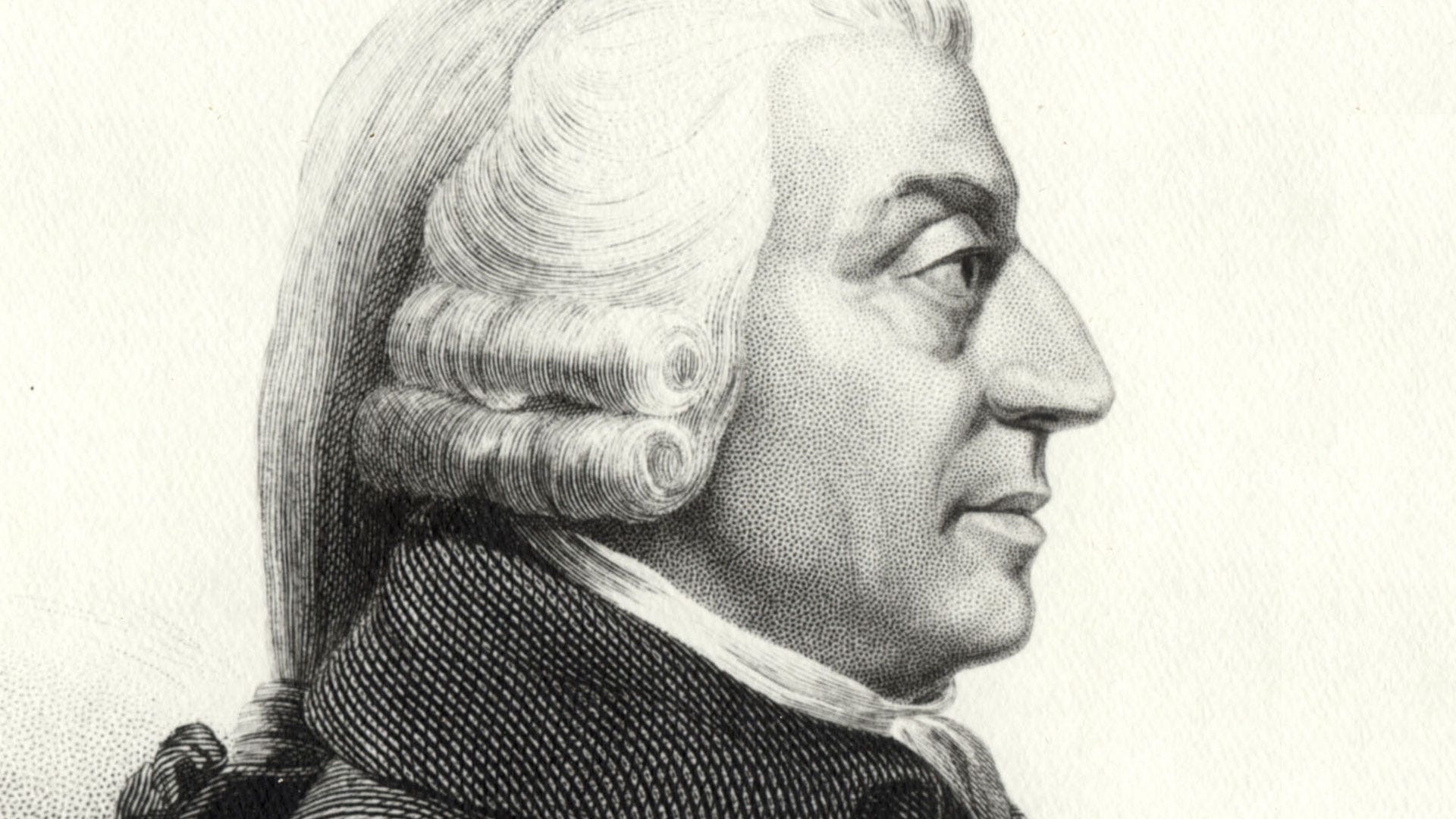
Not only did America declare its independence from Britain 250 years ago, but the man presumed to be the father of conservative economics published his opus, The Wealth of Nations, 250 years ago this month.
It, too, was revolutionary.
Adam Smith’s masterpiece is one of those rare classics that almost everyone knows about, many people quote from, but a very few have actually read. Yet it ranged over issues as fresh and topical now as they were in the late eighteenth century—jobs, wages, politics, government, trade, education, business, and ethics.
And it was hardly conservative, then or now.
Smith was no “economist” as we now define that specialty, and he didn’t write in complicated, mathematically-infected jargon understandable only to fellow specialists. He called himself a “moral philosopher,” intent on explaining why people and societies function the way they do, and also how they should function.
He wrote for the broad public in a style that’s still clear — often witty; rich with digressions into history, religion, and then current affairs like the “disturbances” in the American colonies; and full of vivid illustrations and metaphors to make his points.
The time in which Adam Smith lived was bursting with the consequences of a very big new idea. The old order of church and royal prerogative was giving over to the revolutionary concept that societies existed for the people who lived within them.
It’s no accident that An Inquiry into the Nature and Causes of the Wealth of Nations (a title usually shortened to The Wealth of Nations) appeared the same year that Americans declared themselves free and independent citizens, with a natural right to life, liberty, and the pursuit of happiness.
The leading thinkers of the Enlightenment, as this age is now called, assumed that individuals would naturally and inevitably strive to make better lives for themselves, to maximize their own satisfaction and happiness.
This didn’t mean that people were selfish or that they had no use for patriotism or religion. It meant simply that their basic motive was to improve their lot in life. It followed that a good society was one which allowed its citizens to do so.
Adam Smith’s ideas fit perfectly with this new democratic idea. To him, the “wealth” of a nation wasn’t determined by the size of its monarch’s treasure or the amount of gold and silver in its vaults, nor by the spiritual worthiness of its people in the eyes of the Church.
A nation’s wealth was to be judged by the total value of all the goods its people produced for all its people to consume. To a reader in the. twenty-first century, this assertion may seem obvious. At the time he argued it, it was a revolutionary democratic vision.
2.
The Wealth of Nations is resolutely about human beings—their capacities and incentives to be productive, their overall well-being, and the connection between productivity and well-being.
In the very first sentence of his Introduction, Smith takes aim at the mercantilists and declares, “The annual labour of every nation is the fund which originally supplies it with all the necessaries and conveniences of life. . . .” And two paragraphs later he states that a nation’s wealth grows because of “the skill, dexterity, and judgment with which its labour is generally applied.. . .”
Smith’s concern about all of a nation’s working people is evident. In a wealthy nation “a workman, even of the lowest and poorest order, if he is frugal and industrious, may enjoy a greater share of the necessaries and conveniences of life than it is possible for any savage to acquire.” In the rest of the book he explains why this is so.
While Smith’s earlier work, The Theory of Moral Sentiments, showed how normal, self-interested people could make moral judgments by consulting an internal “impartial spectator” (akin to their conscience), in The Wealth of Nations Smith explained how such people will automatically contribute to the well-being of others even absent such consultations, simply by pursuing their own ends.
“It is not from the benevolence of the butcher, the brewer, or the baker, that we expect our dinner,” writes Smith, in one of the most frequently cited passages in the history of economic thought, “but from their regard to their own interest. We address ourselves, not to their humanity but to their self-love. . . .”
With several strokes of his pen, Smith thereby provided a moral justification for motives that had been morally suspect in Western thought for thousands of years.
How can self-interested behavior—the “private interests and passions” of men Smith calls them—lead to the good of the whole? By means, he says, of an “invisible hand”—perhaps the most famous, or infamous, bodily metaphor in all of social science.
By an “invisible hand” Smith did not mean a mystical force; he was referring to an unfettered market propelled both by competition among self-interested sellers and by buyers seeking the best possible deals for themselves.
If sellers produce too little of something to meet buyers’ demands, for example, the price of the product will rise until other sellers step in to fill the gap. If some sellers charge too high a price to begin with, others will step in and charge a lower one.
Unimpeded, the invisible hand will allocate goods efficiently. But the key to wealth creation, for Smith, came in the division of labor—by which individuals specialize in doing or producing a particular thing.
Smith famously illustrates this principle by reference to the making of pins within the kind of small factory that characterized the early years of the Industrial Revolution.
“One man draws out the wire, another straights it, a third cuts it, a fourth points it, a fifth grinds it at the top for receiving the head; to make the head requires two or three distinct operations .… I have seen a small manufactory of this kind where ten men only were employed . . . [who] could make among them upwards of forty-eight thousand pins a day.”
He contrasts this with the likely output of individuals who tried to make the entire pins themselves. “[I]f they had all wrought separately and independently … they certainly could not each of them have made twenty, perhaps not one pin in a day. . . .”
Specialization improves productivity because it allows workers to become more skilled in their specific tasks, motivates them to discover more efficient means of doing them, and saves them the time of changing over to different tasks.
Here, Smith noticed something that modern managers often overlook: Innovation often begins with the workers closest to the things being worked upon.
“A great part of the machines made use of in those manufactures in which labour is most subdivided, were originally the inventions of common workmen, who, being each of them employed in some simple operation, naturally turned their thoughts towards find-ing out easier and readier methods of performing it.”
In order to reap the full benefits of specialization, the market must be sufficiently large. After all, there’s little point in creating forty-eight thousand pins if there aren’t enough people to buy them. The larger the market, the greater the opportunities for specialization.
It follows that barriers to trade, within a nation or between nations—regulations, licenses, tariffs, quotas, and other market protections—reduce potential wealth.
At the extreme, the necessity of self-sufficiency causes hardship, as in “the lone houses and very small villages which are scattered about in so desert a country as the Highlands of Scotland, [where] every farmer must be butcher, baker, and brewer for his own family.”
3.
Smith did not live to see large-scale industrialization and the scandalous conditions of urban poverty, unsafe workplaces, child labor, and pollution that scarred the nineteenth and twentieth centuries.
One of the ironies in the history of ideas is that The Wealth of Nations—a book ded-icated to improving the welfare of the common man rather than just the merchants or nobility—should have been used by the rising class of industrialists as justification for not seeking to remedy these and related social ills.
Smith did not argue against government per se. He opposed the use of government by economic interests seeking to block commerce for their own benefit. “People of the same trade seldom meet together, even for merriment and diversion, but the conversation ends in conspiracy against the public, or in some diversion to raise prices,” he warned.
Such conspiracies against the public resulted in monopolies, restrictive preferences, privileges, and protections that hurt the common man while enriching vested interests with the power to “intimidate the legislature” into giving them what they wanted.
In fact, Smith was concerned about the consequences of factory work for the character of working people. A worker required to do the same simple operation repeatedly would have “no occasion to exert his understanding, or to exercise his invention in finding out expedients to removing difficulties,” Smith thought. Such a person “therefore loses the habit of such exertion, and generally becomes as stupid and ignorant as it is possible for a human creature to become.”
The virtues of the laborer would decline, Smith warned, “unless the government takes some pains to prevent it,” including the provision of education.
Smith railed against the English Poor Law that put unemployed people in an impossible bind—requiring them to maintain residency in one place in order to be eligible for welfare relief, and therefore not move to where work might be available.
Nor was Smith fond of the rich, whose “chief enjoyment of riches consists in the parade of riches, which in their eye is never so complete as when they appear to possess those decisive marks of opulence which nobody can possess but themselves.”
Smith advocated a progressive income tax, by which citizens contributed “in proportion to the revenue which they respectively enjoy under the protection of the state.”
In all these respects, Adam Smith’s thinking is as relevant to the twenty-first century as it was to the eighteenth.
Globalization and technological advances have created wondrous opportunities, yet have also caused corporations and their CEOs to seek special advantage through monopolization, trade protection, and myriad special tax benefits and subsidies. Lobbyists swarm over Washington, D.C. and the capital cities of other nations seeking favors for groups with the money and power to claim them.
At the same time, a good education still eludes many, welfare benefits are still designed in such a way as to make it difficult for the poor to move ahead, and tax systems are still riddled with loopholes in favor of the better off.
In these times, as when Adam Smith wrote, it is important to remind ourselves of the revolutionary notion at the heart of Smith’s opus—that the wealth of a nation is measured not by its accumulated riches, but by the productivity and living standards of all its people.
This post has been syndicated from Robert Reich, where it was published under this address.