
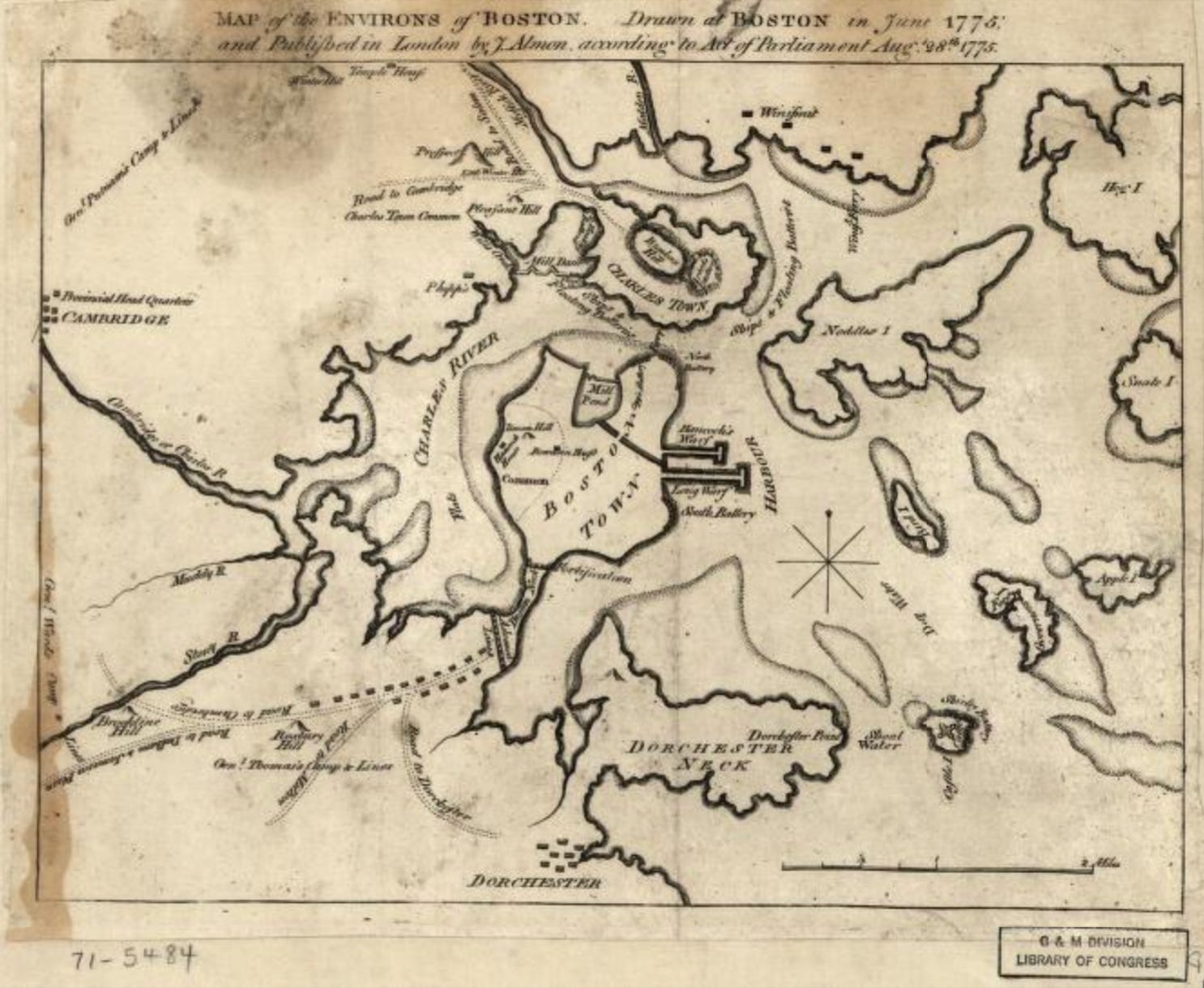
In early 1775, the people of Boston were bitterly divided. The town was on a peninsula that was almost an island, connected only by a narrow spit of land on which four horses could walk abreast at high tide. There, and on the surrounding lands—Medford, Charlestown, Cambridge, Brookline, Roxbury, Dorchester Heights, Noddle Island, and Governor’s Island—and in the vessels in Boston Harbor and beyond, men, women, and children were weighing their loyalties.
Trouble had been brewing in the town for at least three years. On the one side were British soldiers and the loyalist subjects of the Crown called Tories. Challenging them were the civilians called Patriots. They wanted to restore the traditional rights of Englishmen that were under attack in the colonies. After the Patriots had thrown more than 300 chests of valuable tea into Boston Harbor on December 16, 1773, to protest Parliament’s claim that it had the right to tax the colonists without their consent, officials from the British government had set out to make the Patriots do as they were told.
They sent 10,000 soldiers and their families to Boston, where the lower-class soldiers competed for housing with the locals. Sometimes soldiers deserted and took local jobs, which had grown scarce as the occupation ruined the local economy. There was little love lost between the Boston colonists and the soldiers newly arrived from England.
Loyalties were less clear among the wealthier people in Boston. While poorer Patriots and soldiers jostled in the streets, British officers and loyalist Tories mingled in places like the fashionable London Book Store on Cornhill Street. There the young bookseller, 25-year-old Henry Knox, had on his shelves the latest volumes from the other side of the Atlantic. Knox was well read himself and was fascinated by military strategy and tactics, an interest he fed through his book orders and by chatting with the soldiers who came to his shop.
Knox brought his military knowledge to his support for the Patriot cause. But his political loyalties did not diminish his admiration for Lucy Flucker, the daughter of prominent and wealthy Tories, when she came with the other fashionable young women to his bookshop. She returned his admiration, and the two married in June 1774 despite her parents’ objection to Henry due to his politics. Her parents reluctantly allowed their daughter to marry but disowned her of her inheritance.
The battles of Lexington and Concord on April 19, 1775, meant that Bostonians could no longer be neutral in the growing tension between the Tories and the Patriots. They would have to choose where their loyalties lay: with the Patriots trying to protect their traditional rights or with the Tories claiming the king had new, radical powers that override the rights of Englishmen.
Even before the British soldiers made it back down the Battle Road from Concord on April 19, militiamen—both white and Black, free and enslaved—from the Massachusetts countryside, furious that soldiers of their own government had shot at them and killed their neighbors, rushed to surround Boston, laying siege to the soldiers and British officials there. Townspeople like Henry and Lucy Knox had to decide where to place their loyalties.
It was not an easy question. In May the Second Continental Congress sent the Olive Branch Petition asking King George for reconciliation, a petition the king rejected, and in June, British general Thomas Gage declared Massachusetts to be in a state of rebellion but offered amnesty for all who would lay down their arms…except for Patriot leaders Samuel Adams and John Hancock. If the Patriots failed, association with them could mean prison or worse.
With his ties to the town’s Tories—including his wife’s family—and knowledge of artillery, Knox could have found a position with the British. Instead, he chose the Patriots. He escaped Boston to join the men besieging the town, helping his comrades build fortifications around the city. Lucy chose to flee with him, leaving her family behind. While Henry camped near Boston, Lucy moved around, alone and unsettled, from the homes of friends to rented rooms in Worcester.
The standoff in Boston began to force others to take a stand as well. Everyone knew that Fort Ticonderoga, 300 miles away near the confluence of Lake Champlain and Lake George in New York, was fortified with heavy cannons that could make or break a battle, and that they were guarded by only a small detachment of two officers and forty-eight men, most of whom were unfit for regular military service.
In May 1775, British General Thomas Gage warned the governor of Quebec he must fortify the Ticonderoga fort at about the same time the Massachusetts Provincial Congress authorized Benedict Arnold of Connecticut to raise men to capture the cannons. Arnold knew that area well, and he and his men set out. Connecticut also raised militiamen to seize the fort, and Vermont’s Green Mountain Boys, led by Ethan Allan, were already on their way. The forces came together and worked their way through the woods to the fort. At dawn on May 10, nine days before the governor of Quebec received Gage’s letter, the Patriots captured Fort Ticonderoga in a surprise attack that found the defenders asleep in their beds. The Patriots seized more than 180 cannons and other weapons.
While the militiamen repaired and strengthened the fort, lines around Boston were hardening. From England, military reinforcements of 4,500 men, led by three new commanders including Sir William Howe, arrived in Boston. Because ships of the British navy and Tory allies controlled the harbor, protecting the soldiers in the town and bringing in supplies, the Patriots could not advance.
But neither could the British officials. British soldiers seized Charlestown at the Battle of Bunker Hill on June 17, but their victory did not settle anything. The British took heavy casualties and did not break the Patriots’ lines, teaching the Patriots that they could hold off the British Army.
The leaders of the Second Continental Congress in Philadelphia recognized the importance of events in Boston. They took control of the forces surrounding the town and created the Continental Army. Recognizing that the Patriots’ reputation for radicalism worried tentative supporters, Massachusetts leader John Adams proposed appointing George Washington of Virginia “General and Commander in Chief.”
Washington arrived at Cambridge to take command in July. He and Henry Knox became fast friends as the two sides in and around Boston settled down into local skirmishes. As the British restricted guns in the town, most Patriots left, joining the Continental Army growing outside the town. Riflemen and militias arrived from Virginia, Maryland, Pennsylvania, and New Jersey, as well as the New England colonies: Rhode Island, New Hampshire, Connecticut, and the Green Mountains.
Continental soldiers dug trenches and drilled, turning from militia into trained soldiers. At the same time, loyalists from the countryside took refuge in the city, where people went without food or wood for cooking and heating, and horses grew gaunt without enough hay. But because the British could bring in supplies over water, the town held on.
By fall, it was not at all clear that the Patriot cause would survive. The Patriots had allies in the fishermen who harassed British shipping, but while shortages squeezed Boston’s inhabitants, the British soldiers had dug in. There was no sign they could be dislodged, and the enlistments of the Continental soldiers would expire at the end of the year. If the Patriots couldn’t rid Boston of the British soldiers and their Tory allies, the revolution might well die in its cradle.
Knox had developed a plan to retrieve the cannons from Fort Ticonderoga, and in November Washington ordered him to go ahead. Knox made the trip quickly, arriving on December 5 at Ticonderoga, where he selected 59 cannons, mortars, and howitzers to transport back to Boston.
It would not be easy. Some of the cannons weighed more than 5,000 pounds each, and together they weighed about 60 tons. Knox’s men loaded the weaponry on handmade barges to cross 32 miles of Lake George before it turned to ice, then carpenters on Knox’s crew built “42 exceeding strong sleds.” Knox rented horses to drag the sleds, laden with artillery, to Albany. Snow made it easier to move the cannons across the land, but the ice on the rivers was so thin the sleds crashed through it twice. The men recovered all but one of the weapons from the icy water, helped by locals who supported the cause.
What Knox called “a noble train of artillery” continued into Massachusetts and crossed over the Berkshires, into the Connecticut River Valley, and on to Worcester, where Henry got to see Lucy. Finally, after ten grueling weeks, on January 25, John Adams reported seeing the cannons pass through Framingham, where they were outfitted for new service. In early March, Knox delivered the cannons to Washington in Cambridge.
Washington placed some of the cannons at Lechmere’s Point and at high points in Cambridge and Roxbury to fire on the town while the Patriots moved the rest of the cannons to Dorchester Heights. From there, Continental soldiers could threaten not only the soldiers in the Tory town, but also, at last, the warships in Boston Harbor.
On March 2, 3, and 4, the British soldiers and Washington’s men traded fire as Continental soldiers built defenses out of timber and brush out of sight of British spyglasses. And then, on the night of March 5, under cover of darkness, the Patriots moved their guns and defenses into position on Dorchester Heights.
“My God,” General Howe said when he saw the fortifications. “These fellows have done more work in one night than I could make my army do in three months.” The British shot at the defenses, but their shot fell short. Remaining loyalists in town wrote a letter to Washington, promising him that the British would not burn the town if the Patriots would let them leave unmolested. Washington agreed.
General Howe ordered the soldiers to torch the town if anyone disturbed their departure. On March 10, he began to load the British ships with soldiers and the Loyalists who wanted to go with them, including Lucy Knox’s parents, who would never see their daughter again. For a week, March winds battered at the loaded ships, keeping them trapped in the harbor. Finally, at 4:00 am on March 17, 120 ships carrying more than 10,000 soldiers and more than 1,000 Tories weighed anchor and left Boston.
That evacuation, 250 years ago tomorrow, was a major victory for Washington and the Continental soldiers, illustrating that a ragtag bunch of countrymen and women, working together, could beat the military might of the British army and navy when it turned against its own people. Watching the British retreat reinvigorated the Patriots after a discouraging winter and gave them confidence that their determination to protect their rights was not only a just cause, but a winning one.
The ships sailing out of Boston Harbor helped solidify that message. They carried the town’s Tories with them, enabling the Patriots to strengthen their community and spread their principles of independence to previously unaligned neighbors without either British officials or reactionary neighbors silencing them.
What began in Boston spread across the colonies as neighbors brought their carpentry and maritime skills, cooking and medical understanding, military tactics, and endurance to the cause of liberty. The evacuation of Boston had taught them that if they worked together, those skills would be enough to rout the world’s strongest military.
Less than four months after the British ships left Boston Harbor, the Patriots took the extraordinarily daring step of declaring independence from the King. They signed a document pledging to each other that they would dedicate their Lives, their Fortunes and their sacred Honor to creating a brand new nation.
[Map of Boston in 1775, from the Library of Congress, Geography and Map Division]
This post has been syndicated from Letters from an American, where it was published under this address.