
On the cusp of a December 16 county hearing in Georgia on a proposed law to regulate the booming data center industry, documents uncovered by DeSmog reveal that lobbyists continued to influence county leaders to revise planning regulations in favor of developers.
Over the past year, Coweta County, about 40 miles southwest of Atlanta, has become a national hot spot for proposed artificial intelligence (AI) data center projects and a growing national public backlash against plans to build the enormous computing factories in rural areas and small towns.
“Project Sail,” a $17 billion data center to be built on about 831 acres of the county’s rural conservation land — the equivalent of 600 football fields — has ignited opposition from residents concerned about its impacts particularly about sound and light pollution and the destruction of woodlands.
Residents are also worried about potentially skyrocketing utility bills from the data center’s 900-megawatt power capacity, and that fact that it will consume up to nine million gallons of water a day, as stated in Atlas Development, LLC’s rezoning application for the project.
Yet, they have not had the access to county decision makers like data center lobbyists have, new documents show.
Public records obtained by DeSmog show that real estate titan Prologis, which is developing Project Sail with land owner Atlas Development, sought to influence support for its project through in-person meetings and email correspondence with Coweta County officials.
DeSmog previously reported how representatives for several data center developments, including Project Sail, lobbied Coweta County officials to weaken rules for the project in an earlier version of the draft ordinance, or local law, which county staff began in May.
The newly uncovered emails show closer contact than previously thought between Coweta County commissioners and Project Sail developers in the weeks leading up to an August 19 public hearing on the new data center ordinance — the first date it was eligible for a vote by the county’s five commissioners.
For example, on July 26, Commissioner Jeff Fisher scheduled with Atlas Development representative Leigh Ann Green a meeting with Prologis representatives on July 29 at the real estate law office Lawson, Beck & Sandlin LLC, in Newnan, GA, according to the new documents. The subject of that meeting was not specified in the emails.
Residents Say They Were Shut Out
Laura Beth, chairwoman of the Citizens for Rural Coweta community group, which formed in January to oppose Project Sail, says that local residents have not had the same opportunity.
“Coweta County has not met with us specifically about the ordinance,” Beth told DeSmog. “A few of us did speak over the phone with [county officials] when the earlier drafts were released.”
However, emails sent about community concerns received only short-worded responses, if at all, she said. “I was told by one commissioner they could not speak to us over the phone and all communication must be done in a group email,” Beth said.
Despite limited contact with residents, county commissioners and staff continued to meet with Prologis.
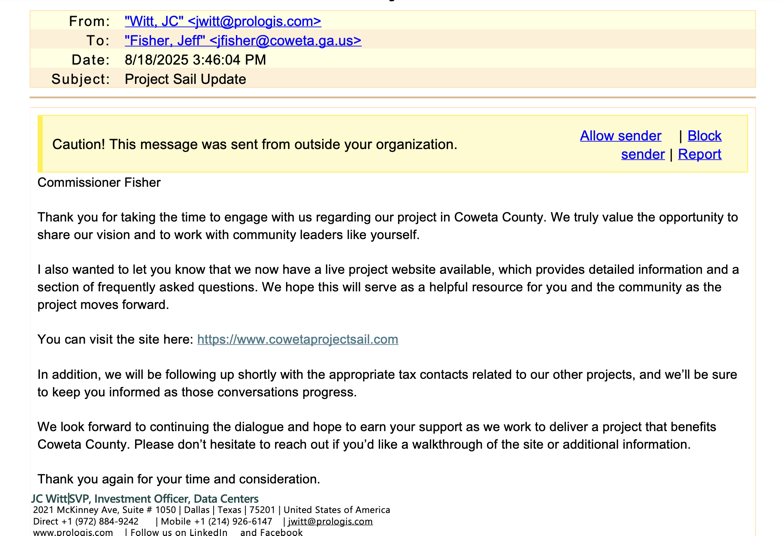
JC Witt, a Prologis vice president, wrote to county commissioners numerous times to win favor for the company’s project, documents show.
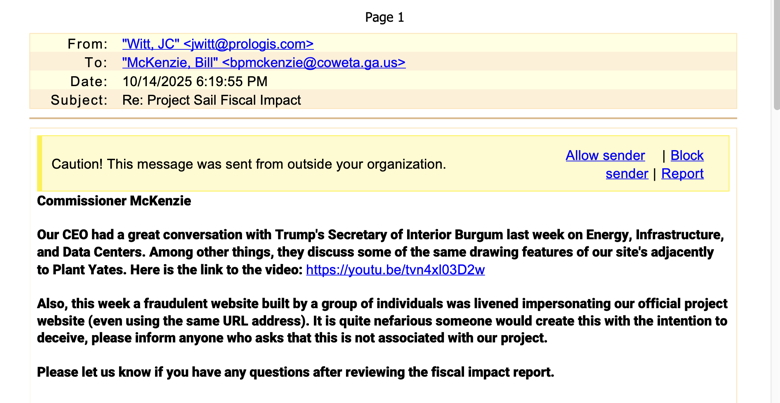
Witt emailed county commissioners on October 1, October 14, and October 27 with additional, favorable information about Project Sail and data centers, even name-checking President Donald Trump administration officials, according to the records, as well as warning of a “nefarious” website impersonating Project Sail representatives.
“Our CEO had a great conversation with Trump’s Secretary of Interior Burgum last week on Energy, Infrastructure, and Data Centers,” Witt wrote on October 14 to four commissioners: Fisher, John Reidelbach, Bob Blackburn and Bill McKenzie, all Republicans, referring to Trump’s pro-data center Secretary of Interior Doug Burgum.
Just last week, Trump signed an executive order to “remove barriers to United States AI leadership” and to empower the U.S. Attorney General to “challenge State AI laws” that run contrary to federal AI policy.
Witt also sent County Commissioner Al Smith, a Democrat, a video link to an interview on CNBC with technology investor Robert Smith about the economic impact of artificial intelligence.
‘Stop Project Sail’ Group Set Up
Since Georgia land developer Atlas Development first announced the data center plans in December 2024, hundreds of residents have mobilized to oppose the project in a bid to conserve the area’s rural character, including forming the Citizens for Rural Coweta community group. Over 3,900 people are registered on the “STOP Project Sail Newnan Data Center” Facebook page, one of the most active social media groups nationwide calling for stricter limits on data center development.
Witt, the Prologis vice president, met with county commissioner Smith on August 14 as well as County Administrator Michael Fouts sometime later that week, according to the email records. On August 18, the day before the public hearing on the data center ordinance, Witt wrote all five county commissioners emails, some of which were personalized, giving them an “update” on Project Sail.
County Commissioner Reidelbach scheduled to participate in an August 18 tour of a data center in Lithia Springs, GA, organized by Atlas Development consultant Leigh Ann Green, alongside six members of the Association of County Commissioners of Georgia, according to the emails. A week before the trip, Reidelbach asked Green to add state Senator Matt Brass to the group.
Instead of holding the planned vote on August 19, Coweta County commissioners decided that day to delay a final vote on the draft data center law. The next week, local residents began receiving flyers promoting Project Sail. Prologis executive Witt appeared on a local radio station to promote the data center complex, and when asked about the county’s ordinance drafting process, he said, “’We’re not involved in any of that,” even though emails show Project Sail partners lobbied county officials to revise the law in their favor.
On September 11, Coweta County held a hearing on the data center ordinance at a widely attended meeting at the County Fairgrounds. At that hearing, commissioners decided to continue working on the law amid public pressure for more revisions, again pushing back a final vote.
Witt met with some of the commissioners at the Adams Supper on October 16, a networking event for the region’s business and political leaders, according to emails he sent to the commissioners on October 27. Georgia Gov. Brian Kemp also attended the event, according to a photo posted on social media by state Sen. John F. Kennedy.
“We have continued to communicate with members of the community, including staff and commissioners, as part of the normal entitlement process,” Prologis spokesperson Mattie Sorrentino said, when asked for comment about the company’s recent contact with local officials.
Project Partners Weigh In
Coweta County convened another public hearing on the data center ordinance on November 18, during which a final vote was again pushed back amid widespread calls by locals to strengthen the draft regulations to take in their concerns.
While county residents have been almost unanimously in favor of a stricter data center ordinance during months of hearings, industry insiders have spoken in favor of looser regulations.
One of them is Mike Lash, senior vice president for the Data Center Solutions team of CBRE, the world’s largest real estate services company. Lash is copied in emails related to Project Sail dating back to February, according to public records, but did not identify his affiliation with the development when he spoke during the November 18 hearing.
Prologis spokesperson Sorrentino said that CBRE is the broker for land owner Atlas Development.
“There are some things in the ordinance that I’ve noticed that are a little bit more onerous than we’ve seen in other counties that have had the same similar ordinances,” Lash said at the meeting.
He asked the commissioners for several changes to the law, including allowing data centers to open onto local “collector” roads, loosening requirements to secure electrical power from utilities before zoning approval, and raising the allowed building height above 60 feet.
His reasoning for the local collector road openings is that “data centers are very low traffic,” he said. But a traffic impact study for Project Sail conducted by the Georgia Regional Transportation Authority notes that the data center development “increases the delay at the intersections that were already failing in the no-build conditions.”
The study showed that at one intersection, the wait time for a vehicle during the morning rush hour would go from 27 seconds in the “no build” scenario to almost 12 minutes if Project Sail is built.
Lash did not respond to a request for comment.
Project Sail’s construction is expected to last 10 years, raising questions about impacts on residents whose homes border the proposed site. During the construction of an enormous Meta data center complex in Richland Parish, Louisiana, for example, vehicle accidents have increased by about 600 percent, according to reporting by the Louisiana Illuminator.

DeSmog visited Richland Parish on December 10-11, where residents described road closures, major delays, and dangerous driving conditions on the roads around the bustling construction site
After the November 18 hearing, Coweta County commissioners adopted all of Lash’s recommendations into the latest draft ordinance, including allowing data centers to open onto local “collector” roads, raising building height limits to 70 feet when roof equipment is included, and replacing a requirement to show “adequate capacity” from the electric utility, with a letter of intent showing “preliminary coordination” to provide power, according to a new draft of the data center law posted on the county website.
Input by Project Sail backers continued at a December 4 public meeting when local real estate agent Craig Jackson spoke in favor of the data center development.
“Project Sail Technology Park is smart growth,” Jackson, who is copied on Project Sail planning emails dating back to October 3, 2024, said at the meeting, according to public records obtained from Coweta County. However, Jackson did not identify his affiliation with the project’s development team at the meeting.
Railey Nash, a real estate agent who works in Pristine Realty alongside Atlas Development consultant Green, also spoke in favor of looser data center regulations.
“Our education system and our first responders are under a tremendous strain,” Nash said. “If you want to leave a true legacy for your children and for your grandchildren, then do what’s best for Coweta County and our future by voting yes for Project Sail.”
Neither Jackson nor Nash responded to requests for comment.
“It is frustrating watching people with close connections to Project Sail come up and speak without acknowledging their role,” Laura Beth with Citizens for Rural Coweta told DeSmog. “From our side of the bar it often appears as if developers have more of the county’s ear than residents.”
Coweta County will consider its draft data center ordinance on Tuesday, December 16 at 6 p.m. in the Commission Chambers in Newnan, with a final vote possible.
The reporting for this story was supported by the Fund for Investigative Journalism.
The post Behind Closed Doors, Georgia County Rewrote Data Center Rules appeared first on DeSmog.
This post has been syndicated from DeSmog, where it was published under this address.