
This article is adapted from Kate Brown’s new book, Tiny Gardens Everywhere: The Past, Present and Future of the Self-Provisioning City, which will be published February 17, 2026, Copyright W. W. Norton & Company.
In 2013, Nicole and Dan Virgil lived in a lush, affluent suburb of Chicago. Dan had a good job. Nicole home-schooled their two kids.
Sifting through channels, they happened upon a documentary about industrial food production. “That’s gross,” Dan said, “Can’t we just buy food that is food?”
Nicole asked around among her friends. “Where do you get real food?”
They stared at her, not comprehending her question.
“Whole Foods?”
Nicole drifted through the aisles of expensive, organic food. Even pricey lettuce after a few days in the fridge wilted and turned slimy. She felt trapped, confined to the industrial food distribution network that girdled the globe.
I could try to grow a head of lettuce, she thought. It can’t be that hard. She was not indentured to the corporate grocer. She was free. Free to grow a head of lettuce. Maybe more.
Nicole hesitated. Her houseplants had always died. Her parents were among the first Black families to move to Stamford, Connecticut, a corporate city. Her father broke the color line to run the city’s music education program. Like many upwardly mobile families, her parents were eager to leave physical labor behind. Nicole does not recall anyone with a vegetable garden in her upscale suburb.
Nicole decided to plant her own garden. She and her husband Dan, an engineer, don’t do things by half-measures. They watched YouTube videos on gardening, checked books out of the library and drew up plans. They built a raised bed and dug a wicking reservoir under it lined to store stormwater and drain the swampy, clay soils. They experimented with two plots. They dropped seeds directly into the spaded-up lawn and other seeds into a fertilized raised bed. Most seeds rotted in the clay soils of the lawn. Those that germinated did not thrive in the nutrient-poor earth, but the seeds in the raised bed sprang up in a few days and thrived, producing in coming months vegetables of deep vibrant colors that were delicious.

I paid a visit to the Virgils in Elmhurst. The Virgil’s front yard is neatly maintained with native flowers and turf grass. From the street, I could see no sign of a vegetable plot out back. In the backyard, Nicole gave me a tour of her garden made up of three long beds stuffed with produce. She and Dan had constructed frames from electrical pipes for the tomatoes and cucumbers to climb ten feet high. Enjoying the shade beneath, potatoes spread. The leaves of bush beans, spinach, chard and kale fluttered in the breeze. Their plants had it all. Air, water, light and soil. Nicole showed me proudly her cherry tomatoes grown from seeds she saved each year. Adapted to the microbes in her soil and their micro-climate, the tomatoes were unusually large, and a rich red color. She pulled vegetables from the garden and we sat down to a delicious salad in their sunny kitchen.
In summer months, Nicole said, the garden provided 90 percent of the family’s produce. Often, they had too much.
Nicole suggested the kids set up a vegetable stand as a home-school project to sell their surplus. Nicole hoped her son would get better at doing math in his head. Before they started, Nicole and the kids made a trip to the Elmhurst Director of Zoning to make sure their vegetable stand was legal. It was. The city did not regulate children’s businesses. The kids designed a logo, got signs printed, and set up a card table on Saturday mornings.
“Did you know, lettuce grows from DIRT?!”
Neighbors asked, “Where did you get all this produce?” The kids showed them their backyard garden. Nicole recalls a woman snapping photos and calling her friend. “Did you know, lettuce grows from DIRT?!”
The vegetable stand was a success. Each child made about $40.00 in spending money. Nicole’s shy son learned how to subtract and talk to strangers.
Autumn comes swiftly to Chicagoland. The Virgils hated to stop gardening. On the web, Nicole noticed farmers in Maine extended the growing season with long, plastic tunnels called hoop houses. You can buy hoop house kits for a couple of hundred dollars, but the Virgils are DIY people. Dan drew up plans for a wood frame connected with PVC pipes. He shored up the supports so the tunnel could withstand 80 mph winds and heavy snow loads. He carefully calculated the height and width of the tunnel to maximize the buildup of passive solar heating inside. They located the hoop house in the middle of the backyard, so it was not visible from the street.
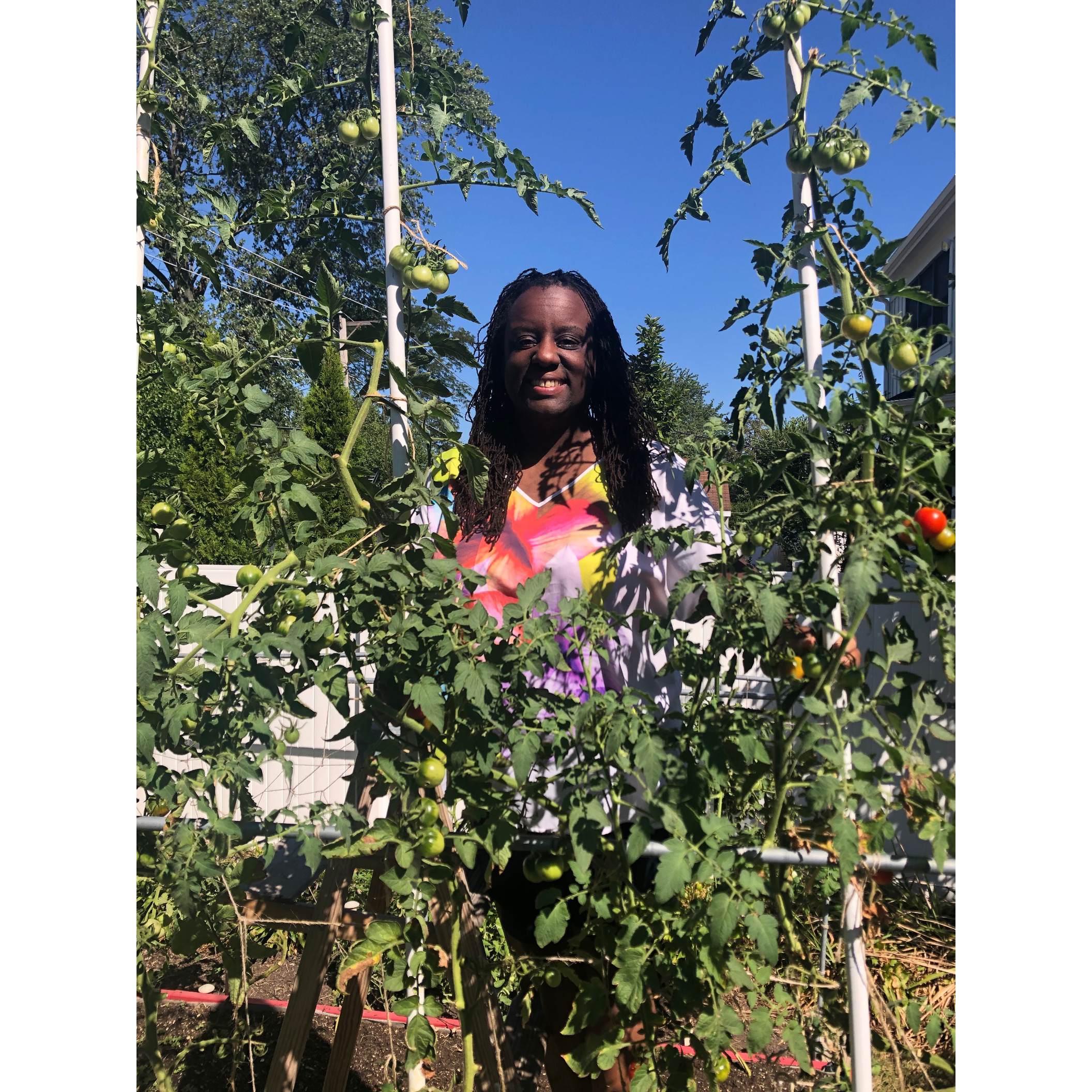
The one thing the Virgils did not think about was the city’s zoning board. Dan and Nicole had lived in Elmhurst for several decades. Elmhurst is a town of squat, white-trimmed, yellow-brick ranch houses placed in the center of spacious lots like iced pastries on a tray. Green lawns frame the houses. The lawns are largely unfenced, rolling along block after block, connecting one neighbor to another, a green communal thread. The Virgils saw neighbors build hockey rinks in their front yards and assemble trampolines and outdoor living rooms in their backyards. They figured the hoop house fell in the same category of a temporary recreational structure. They didn’t count on one neighbor calling the city, asking if the hoop house needed a permit.
One day, they came home to find a Property Maintenance Violation Notice on their front door. The city required a permit for their “greenhouse.” The Virgils stopped building. Dan went down to City Hall and explained their goal—to extend the growing season for a few months. They were not building a greenhouse. They’d take the hoop house down in the spring. He came away with the understanding that as long as the tunnel was temporary, it was ok, like the skating rinks and summer cabanas.
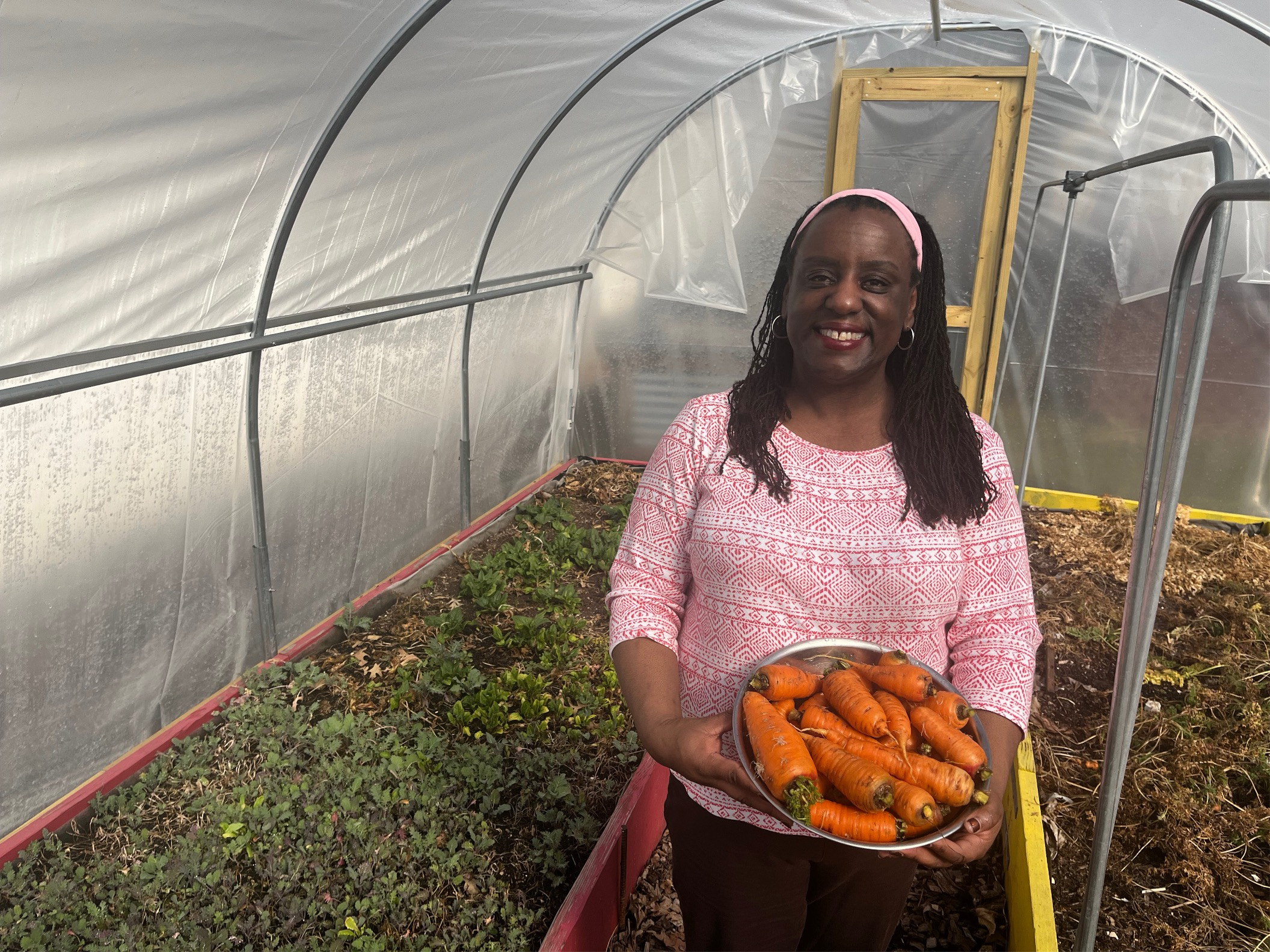
The Virgils loved the hoop house. Temperatures were as much as 50 degrees warmer inside. With snow all around, they worked indoors in short sleeves. The plastic frame extended the season, March was the new May. The family harvested fall crops in December and got a two-month jump on planting spring crops.
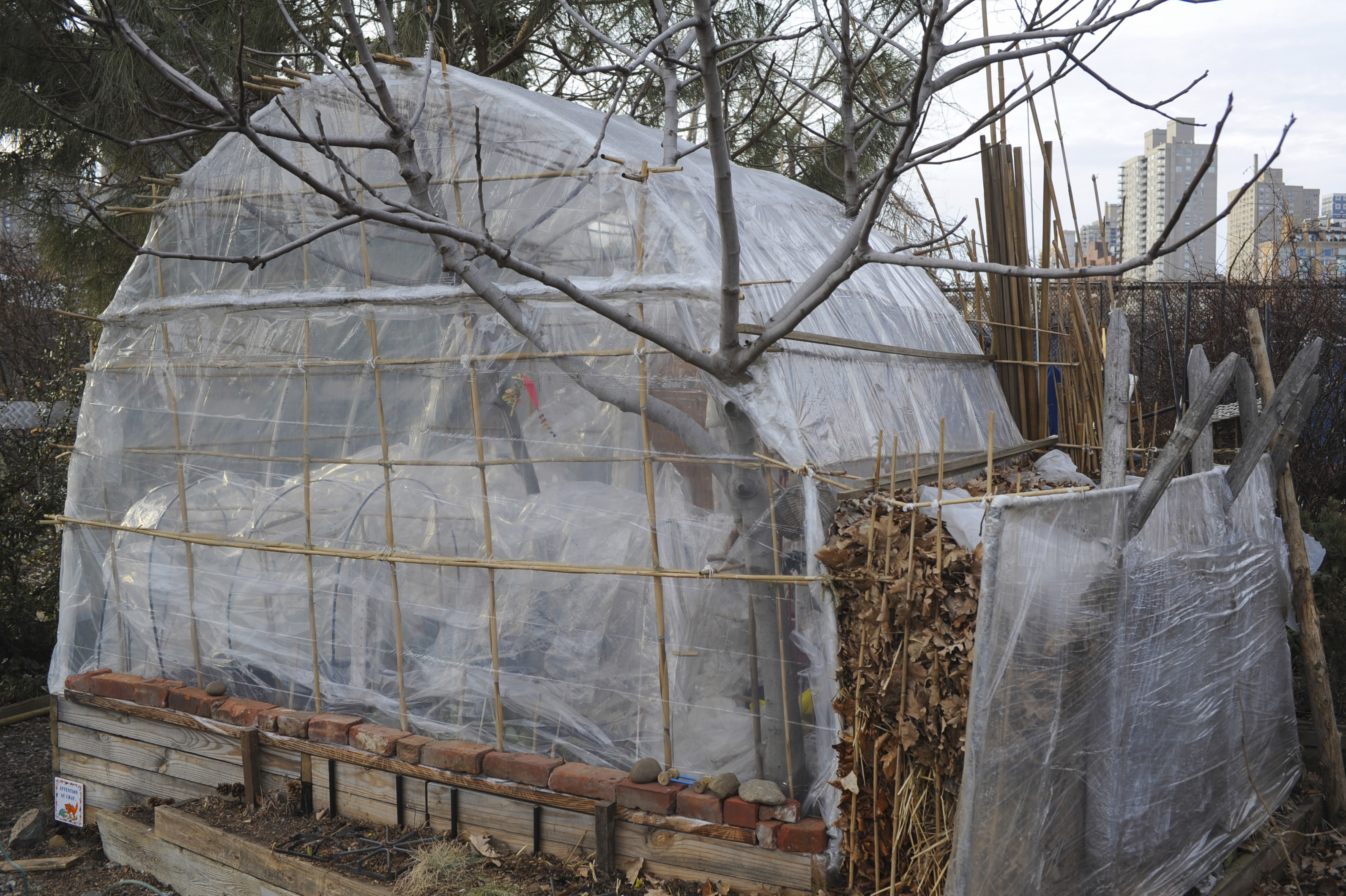
The next fall, frosty winds blowing, they put the hoop house up. Again, the neighbor phoned city hall, this time repeatedly. The neighbor was worried about how the tunnel looked, about possible flooding, about noise from the plastic cover flapping in the wind.
Another citation followed. The Virgils were confused. The City of Chicago allowed hoop houses. They could not find any rules banning hoop houses in the Elmhurst City Code. Indeed, their citations listed no code violation at all. They asked what code or ordinance they had transgressed. City staff didn’t know. They said they would get back to them on that. A letter arrived a few weeks later stating they had violated two codes, one about occupancy of a tent or temporary structure in a residential zone and the other from the permanent building code banning membrane structures altogether. That was confusing. How could the hoop house be both a temporary and a permanent structure?
Elmhurst officials told the Virgils they could get a variance to change the municipal code, but it would cost $6,500 for their $100 structure. The Virgils asked if they could work with city council members to write a new code. That would be fun, they thought, helping to draft new laws to make their community more sustainable. The kids would get a civics lesson. Two city council members offered to sponsor the bill, but the City Manager would not entertain the idea. He told them to take the hoop house down.
The Virgils got a lawyer, had a hearing, and lost. They won on appeal but lost again when the city attorney appealed their victory.
The suggestion that she could not pursue a dream lit a fire under Nicole. Nicole is like that. When her high school music teacher told her she did not have the voice for opera, she trained even harder and became an opera singer.
Nicole called local CBS news. She talked to print reporters. Supportive neighbors formed a Facebook group. Nicole started a website, circulated a petition, and contacted urban farms and non-profits. She is articulate, funny, calm, intelligent, and informed to a granular degree. Nicole is a formidable force, but she and Dan were up against two powerful American institutions—the lawn and the suburb.
Nicole is a formidable force, but she and Dan were up against two powerful American institutions—the lawn and the suburb.
Unlike most parts of the world, Americans divide land by use—residential, commercial, agricultural, and industrial. Most suburban residential areas are zoned for single families, a category that excludes nearly everything on a lot but those defined as “basic accessories,” like garages and swimming pools. Like the rows of corn surrounding Chicago, Elmhurst is a mono-crop field with one product—bedroom communities dedicated to rest, relaxation, and consumption.
The Virgils’ hoop house confused city leaders. At city council meetings, they asked: “What are you going to do with all that food?”
“Are you growing food to sell—a commercial venture? Raising food to live on, a subsistence farm?”
A city council member speculated improbably that an (unheated) hoop house could be used to grow marijuana in Chicago in winter.
Why, they were asked, didn’t they just go to Whole Foods like everyone else? Residents in a middle-class community should be able to afford to buy their food.
The journalist and urban theorist Jane Jacobs wrote that suburban communities are utopias. Utopias are great, Jacobs noted, if you have no plans of your own. “As in all Utopias, the right to have plans of any significance belongs only to the planners in charge.” But the Virgils had their own dreams—to produce nutritious, organic food sustainably and affordably. They were turning their suburban lot, zoned for residence and recreation, into a space for production, toiling with their hands like working-class people, instead of consuming, often ostentatiously, as American suburbanites are encouraged to do.
An Elmhurst city council member, Steve Dunn, instructed the Virgils, “We are a sustainable community, but we are not a rural community.” Zoning chairman Michael Honquest concurred: “This is a suburban setting, not an agricultural setting.”
Nicole grew exasperated with these comments. “They tell us, ‘We are not a farming community.’ Well, okay, but I’m on two-tenths of an acre. I am not farming.”
Like the Virgils, I was puzzled. The Virgils do not live in a homeowner’s association or gated community. They own their property. Why can’t they do what they want on it within the parameters of the law? Despite repeated requests, no elected city official from Elmhurst would return my calls and emails. So, my confusion escalated. What harm did the hoop house cause?
It would have been easy enough for Elmhurst officials to investigate, but they didn’t. Had they done so, they might have discovered that the windblown plastic did not roar like a train, and there was no water run-off. On the contrary, the Virgils’ trenched beds absorbed 700 gallons of rainwater each. Nicole claimed that when they invited city council members to visit the hoop house, the elected officials declined. Instead, Elmhurst city officials poured thousands of dollars into judicial procedures and attorney fees to prosecute the Virgils. The case generated hundreds of hours in hearings and staff research. Why did they go to such expense and trouble?
If democratic procedure matters, then the case is even more puzzling. At city council meetings, a majority of attendees endorsed the Virgil’s hoop house and “the right to garden.” At council meetings over several years, less than a dozen people spoke against the hoop house while hundreds voiced support. Some supporters claimed racism was the underlying cause. Dan is white. Nicole is Black in a city that is 94 percent white.
There appears to be evidence to support the fact that plants, which are supposed to be apolitical, do the work of drawing abstract lines of race and class onto the American landscape. In the same years as the passage of the Fair Housing Act in 1968, which made it illegal to discriminate in the sale, rental, or financing of housing, the vast majority of American municipalities passed laws that one way or another left homeowners little choice but to plant turf grass in their front yards. The laws were vague. Residents could have plants no higher than six or eight inches unless they were “useful” or “ornamental.” Vague laws play an important role in the history of segregation. Law enforcement can deploy them as they see fit, and neighbors, as in the Virgil’s case, can weaponize the law by phoning in complaints. Scanning legal records shows an uptick in court prosecution of vegetation laws from just a handful recorded in the 1960s, to several dozen in the 1970s and 1980s, to scores of cases in the 1990s and early 2000s.
In these cases, we found, people charged with growing vegetables in residential communities were more likely to be people of color (usually either Black or a recent immigrant), but not always. In Orlando, Florida, Jason and Jennifer Helvenston, a white couple, plowed up their front yard to grow vegetables. “A budget thing.” The city fined them $500 a day until it was replaced with “approved ground covers.” White defendants usually found it possible to shift vague lawn laws in their favor or overturn fines, but this was rarely the case for non-white homeowners. Tom Carroll and Hermine Ricketts, a mixed-race couple, cultivated a front yard garden for seventeen years. The garden produced 80 percent of their food until the Miami Shores Village Council passed a law banning front-yard gardens and forced the couple to dig up their garden. Ketha Robbins in suburban Columbus, Ohio, sought to restore a forest to her backyard and landed in court.
As anti-gardening cases multiplied, a “Gardening While Black” hashtag appeared on Twitter. In a Detroit case, a Black man was harassed by two white women and then taken to court for gardening with children in a public park. In another case, a man received a ticket for his front yard garden despite no restrictions being listed in the town codes. In Tulsa, months before a scheduled trial to discuss the legality of Denise Morrison’s medicinal plant garden, city workers ripped it out. In Cambridge, Massachusetts, a white neighbor called the police on Black residents meeting in a community garden during the Covid-19 quarantine. She claimed, with no evidence, that the group had torn up plants and removed soil worth $1200.
In the Minneapolis suburb of Falcon Heights, city officials caught wind of Quentin Nguyen removing the sod from his front yard to plant a large garden as part of a neighborhood green initiative. They quickly imposed a one-year ban on front-yard gardens (although the former city mayor had just such a garden). Nguyen, a garden activist, planned to use his two-acre front yard to grow vegetables to give away. But neighbors fretted that the garden was a security issue: “I am worried about normalizing the presence of many different people in front yards during potentially all hours of the day without any kind of restrictions put on access.”
“I am worried about normalizing the presence of many different people in front yards during potentially all hours of the day without any kind of restrictions put on access.”
A neighbor and reported friend of Nguyen testified that the dispute was not “personal.” It “was not racial.” Nguyen, who came to the US from Cambodia as a boy, responded with angry disappointment. He saw his garden as a venue for reciprocal relationships. “I wanted to pay back. Help the community. I feel targeted. I feel my fundamental liberties are invaded.”
The demographics of communities with vegetable bans provide some context for these cases. During the decades of the 1990s-2000s, racial segregation continued to decline in American municipalities, but at a strikingly slowed pace, while segregation by income largely increased. Scanning the national database of municipal regulations, my research assistants found that communities with vegetable bans had 30.4 percent fewer Black, 28.5 percent fewer Asians, 7.8 percent fewer Hispanics, and 12.6 percent more white people than the population of their state. Those communities were also richer, with a 73.5 percent higher median income. This demographic profile supports what geographers call an “ecology of prestige” in which residents of higher-income communities attach greater importance to turf grass. Seeking a deep-green lawn, they apply more pesticides and fertilizer and influence neighbors to do the same. The more homogeneous the social fabric of a community, geographers found, the less likely the neighborhood would have a biodiverse range of plants. In other words, the economic and racial diversity that American communities fail to cultivate is reflected in the plant-scape. Mono-crop vegetation matches mono-crop demography.
The economic and racial diversity that American communities fail to cultivate is reflected in the plant-scape. Mono-crop vegetation matches mono-crop demography.
I asked Nicole if she thought the City of Elmhurst’s grievance about their hoop houses was racial. “I am certainly conspicuous around here,” Nicole noted. But in addition to race, she saw the controversy as circling class: “There’s just this perception that it [the hoop house] is low-brow and low class. That perception is next to impossible to chisel through.”
Ari Bargil, a senior attorney at the public interest law firm, the Institute for Justice, pointed to the general mandate for suburbanites to recreate, not produce. “What a lot of these restrictions are designed to do is prevent people from sustaining themselves.” You can have a small raised bed, Bargil continued, “but they are saying that if you want to eat organic and nutritious food, you still have to go to Whole Foods like the rest of us.”
Working with Bargil and the Institute for Justice, Nicole campaigned to have her state representative draft a “Garden Act.” She made several trips to the Capitol in Springfield, lobbied legislators, and told her story over and over. Finally, six years of stubborn refusal to submit to what she considered arbitrary code enforcement paid off. The “Vegetable Garden Protection Act” passed in June 2021 gives Illinois residents the right to “cultivate vegetable gardens on their property or on the private property of another with the permission of the owner, in any county, municipality, or other political subdivision of this state.” Illinois joined Florida and Maryland in prohibiting homeowners’ associations and municipalities from requiring turf grass and restricting vegetables and native plants.
Nonetheless, Elmhurst’s City mayor vowed to continue to battle against hoop houses in his city. The city council issued a ban on all temporary structures, but finally permitted hoop houses after the Virgils spent a total of seven years fighting for them.
Dan and Nicole Virgil aspired to create a small world in concert with plants—plants attuned to their yards and to them. They are not alone. Other states are considering Right to Garden Laws, and a recent YouGov poll conducted in November 2025 showed that 16 percent of all US households are using their front yard, long a preserve for a lawn, to grow fruits, vegetables, and herbs. These households are part of a quiet movement across the United States to reclaim yards from turf grass to cultivate plants that feed humans, birds, bees, and more resilient communities.
This post has been syndicated from Mother Jones, where it was published under this address.