
Friends,
I was secretary of labor 30 years ago when the U.S. economy was producing an average of 200,000 new jobs a month.
I remember holding news conferences on “jobs days” each month. I felt confident about the strength of the economy. What worried me then was that the new jobs didn’t pay well. (A disgruntled worker once called out to me, “Sure, Mr. Secretary, lots of new jobs. I’m doing three of them to make ends meet!”)
Last Wednesday, the Labor Department reported that the United States produced an average of just 15,000 new jobs per month last year — a record low. And most paid sh*t.
January showed an uptick in jobs, but almost all of the new jobs were in health care and construction. The rest of the economy seems to be shrinking. And wages are still stuck in the mud.
Profits of big corporations have soared. The stock market values attached to these profits have risen even more. Yet average workers are barely making it.
The U.S. economy is more distorted than ever.
The widening gap between corporate profits and average workers — between capital and labor — helps explain the disconnect between a buoyant economy and pessimistic households. Consumer confidence is in the basement.
The gap was widening before Trump was elected. It explains in part the rise of MAGA and why Trump won in 2016 and again in 2024.
But Trump hasn’t done a thing to alter these trends. In fact, since he became president again, corporate profits (and the stock market) have done even better than before, while average workers have seen almost no gains in jobs or wages.
“I think we have the greatest economy actually ever in history,” Trump said in an interview with Fox Business’s Larry Kudlow that aired Tuesday.
That’s not what most Americans think. Even most young men — central to Trump’s wins in 2016 and 2024 — now believe they were better off under Biden.
We’re not powerless to alter these trends. The “free market” doesn’t run on automatic. The rules of the economy depend on political decisions — such as tax laws, antitrust laws, and labor laws.
Since Ronald Reagan was president, the nation has lowered taxes on the wealthy and raised them (especially Social Security and state sales taxes) on average Americans.
America has also allowed big corporations to monopolize the economy — which has given them the power to raise prices without worrying that a competitor will grab consumers away.
And what about labor laws?
Take a look at this chart.
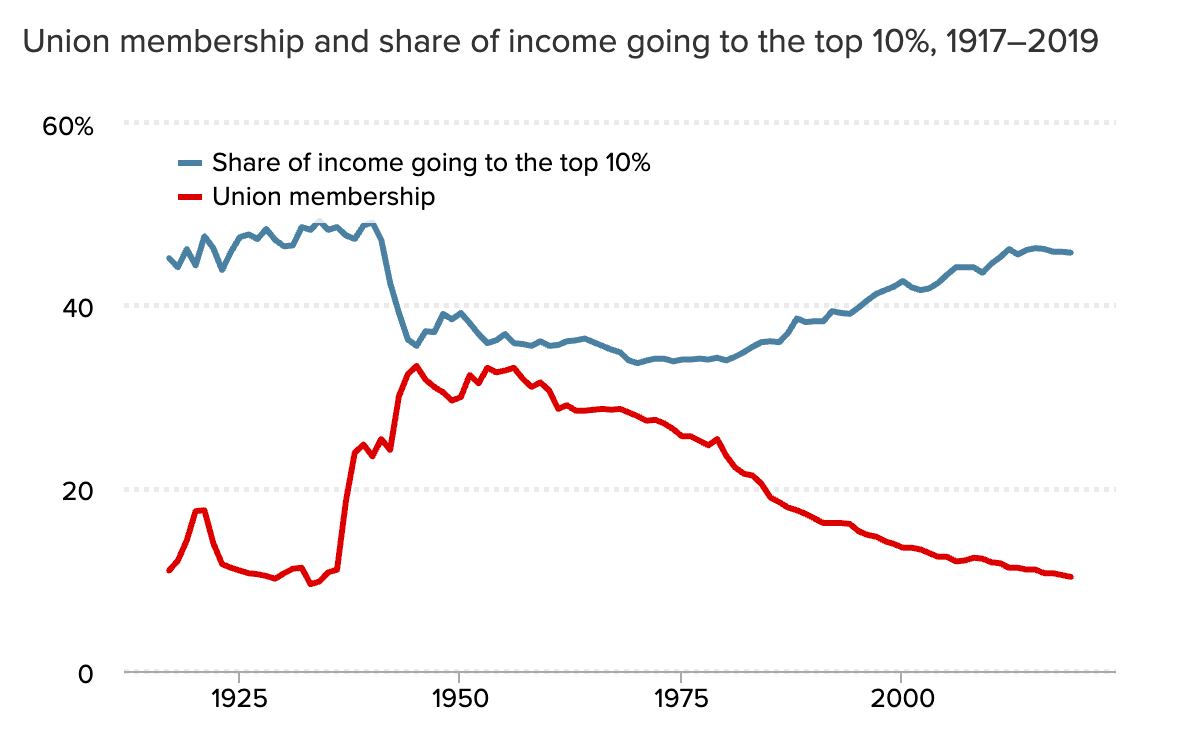
The blue line represents the percentage of the national income going to the richest 10 percent — that is, how much of every dollar earned in the United States goes into the pockets of the wealthiest tenth of Americans.
The red line represents the percentage of workers that belong to a union.
Notice a pattern?
The 1940s and 50s saw a dramatic rise in union membership. Laws and public policies encouraged unionization.
That was also a time when a growing portion of the nation’s income went into the pockets of ordinary working people instead of the pockets of the richest 10 percent.
That’s because unions give workers more bargaining power to get a larger share of the profits they helped generate. The benefits of unions helped nonunion workers too. In order to attract workers, corporations that didn’t have unions had to increase the pay of their workers, too.
As a result, by the mid-1950s, America’s economy was powered by the biggest middle class this nation had ever seen. Racial and gender disparities were still a big problem, but America was making progress on them as income inequality trended downward.
So what happened?
As you can see, union membership started to decline in the 1970s.
That was after Lewis Powell — soon to be a justice on the Supreme Court, then an attorney in Richmond, Virginia — urged the U.S. Chamber of Commerce and the leaders of American corporations to pour great wads of money into American politics.
Corporations doubled-down on busting unions, while their allies in government weakened labor laws.
Then, starting with Ronald Reagan in the early 1980s, corporate attacks on unions got turbocharged. Reagan fired the striking air-traffic controllers. Legally, they had no right to strike, but Reagan’s move legitimized a far broader assault on American unions.
Since then, unions have steadily shrunk, and the gap between the rich and everyone else has taken off. I saw it when I was secretary of labor in the 1990s. I was worried then. I’m far more worried now.
Today, the top 10 percent are doing okay, largely because they own 92 percent of the value of all the shares of stock owned by Americans, and the stock market is doing just fine. The real wealth of the nation has now concentrated in the richest one-tenth of 1 percent.
And the bottom 90 percent are barely holding on.
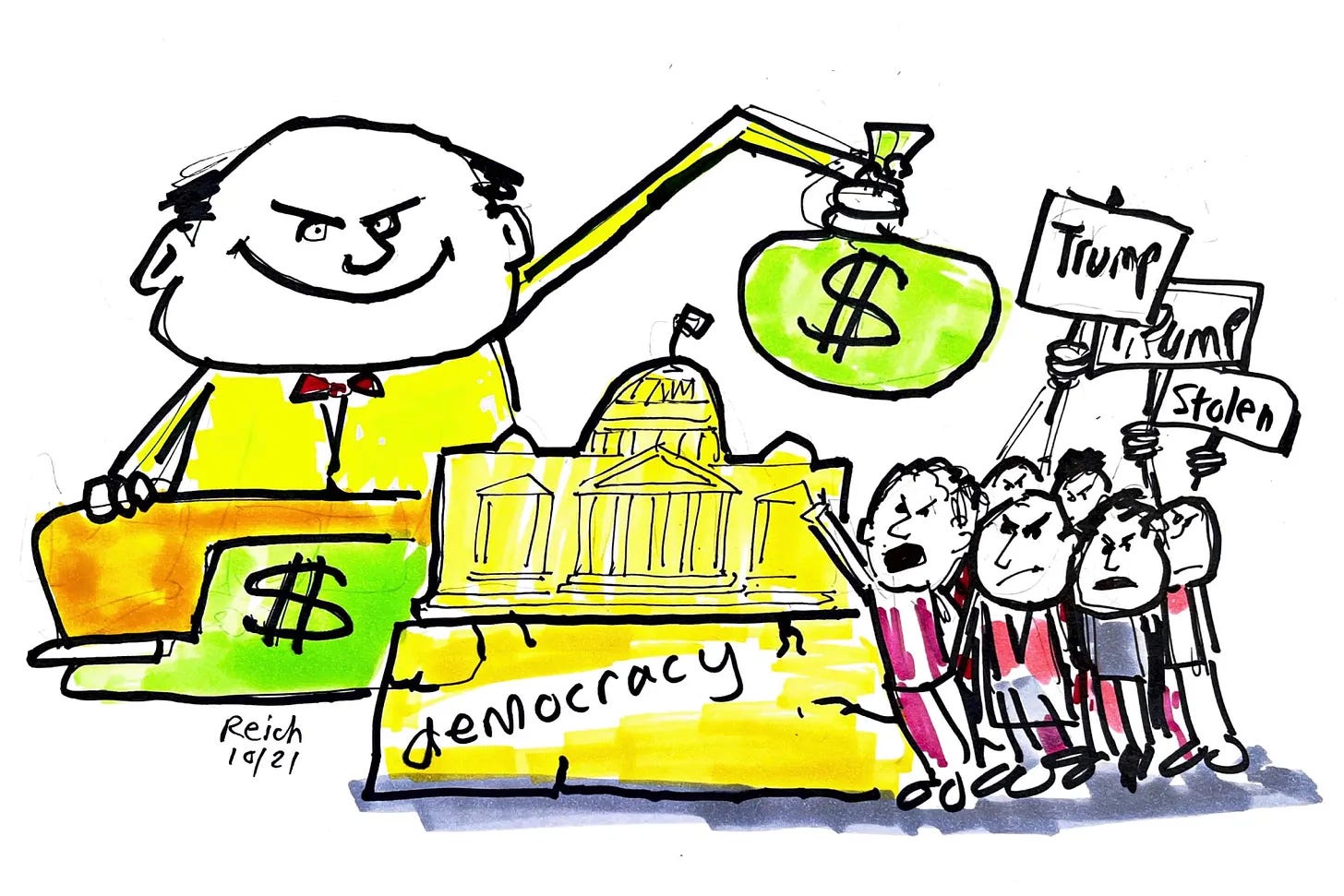
My friends, this is not bad only for the bottom 90 percent. It’s also bad for the economy and dangerous for our democracy. If unaddressed, it could lead to more demagogues like Trump as far as the eye can see.
As the great jurist Louis Brandeis is reputed to have said: America has a choice. We can have great wealth in the hands of a few, or we can have a democracy, but we cannot have both.
If we want to make sure our economy works for everyone, not just the super-rich, we need to build back union power.
A resurgence of labor unions would go a long way toward fighting inequality, rebuilding a large and vibrant middle class, and making life better for all Americans.
Which is why it’s vital that we support unions.
Please take a look below, and share:
This post has been syndicated from Robert Reich, where it was published under this address.