
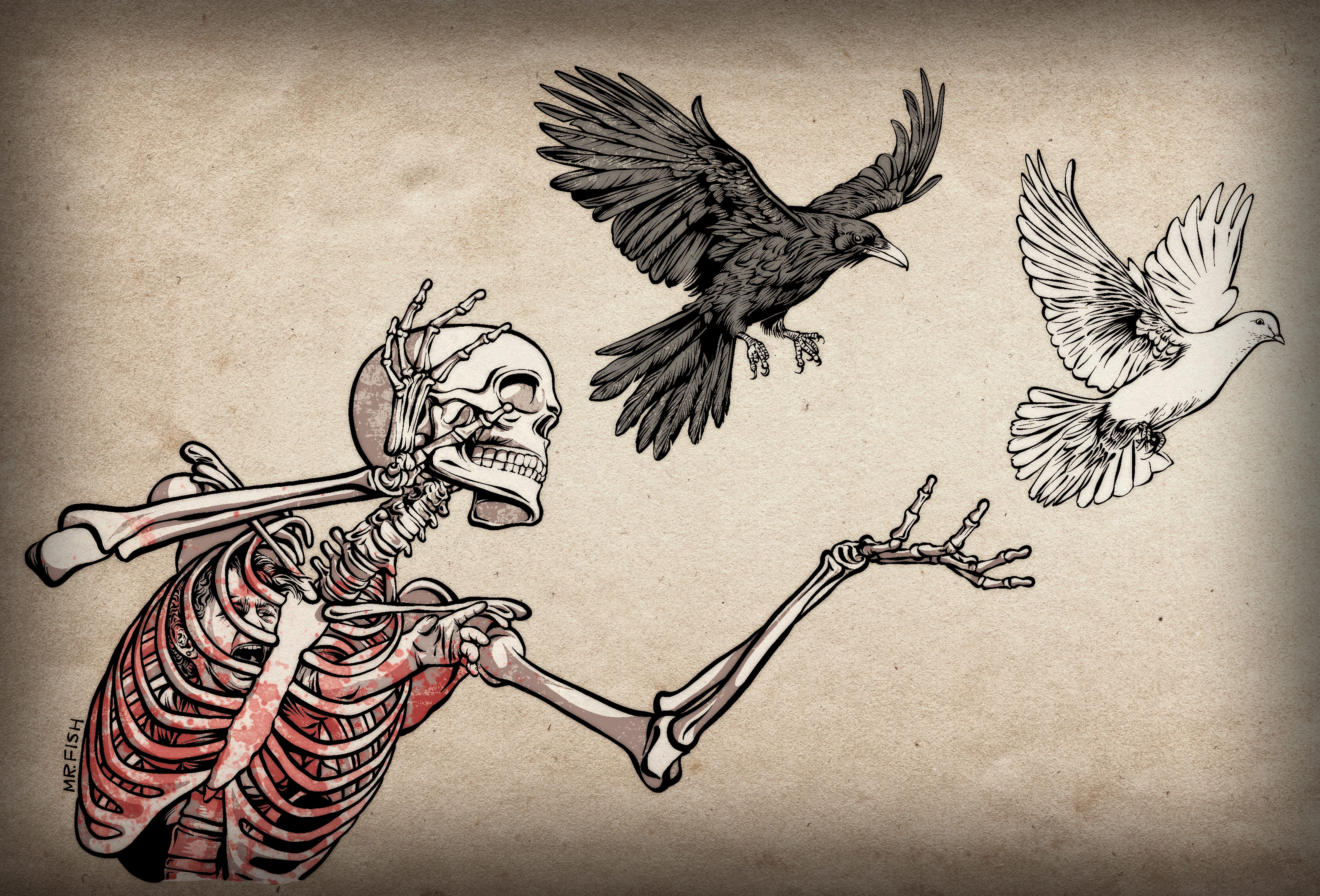
Reaper Madness – by Mr. Fish
NEW YORK: “The Voice of Hind Rajab,” like all great pieces of art, takes a straightforward story — the battle to save the life of a 6-year-old girl, Hind Rajab, trapped in a car in Gaza surrounded by murdered family members — and elevates it to an archetype. This story is as old as time. It lies at the heart of all religious and moral literature. It pits the cruelty and heartlessness of power against the empathy and compassion of the powerless. It asks us what kind of a life we want to live. Is it a life defined by hubris, domination and violence? Or is it a life defined by compassion, justice and self-sacrifice? These are moral, not political questions.
To nurture, preserve and protect the lives of those demonized in war is to be branded a traitor — a subversive, the enemy. It is to risk death. War, and especially genocide, is the quintessential expression of what Sigmund Freud called Thanatos, the death instinct that drives humans towards the destructions of others and themselves. Those who fight for Eros, for life, are eliminated. This schism is at the core of the film. It is the struggle between good and evil, light and dark. And, as so often happens in war, Thanatos prevails. This almost certain defeat gives unquestioned nobility to those who defy the forces of death.
Israel and its supporters do not want the outside world to see the bureaucratic machinery that perpetuates its mass slaughter, but I suspect, even more, it does not want the world to see the humanity of the Palestinians who resist.
It was hard to find a screening. I traveled for over an hour to see it at the Film Forum in New York City, which had just one showing at 4:45 in the afternoon. I understood why. Despite critical acclaim, an Oscar-nominated director and industry heavyweights like Brad Pitt and Joaquin Phoenix behind it, the film — directed by Tunisian filmmaker, Kaouther Ben Hania —faced major difficulties in getting an American distributor — reportedly out of “fear” and disagreement “with the film’s politics,” according to a report by Deadline.
It is not only devastating, not only a cinematic masterpiece, but it rips back all the layers of rhetoric and propaganda to expose the fundamental struggle between the Israeli occupier and the occupied. The struggle is, yes, a conflict about the theft of Palestinian land. It is, as well, a conflict about a violent and lethal occupation, one that has become full-blown genocide in Gaza. But it is also the ancient struggle between the forces of life and death.
Anyone who follows Israel’s murderous rampage in Gaza knows the story of Hind Rajab. On Jan. 29, 2024, the Israeli army ordered the evacuation of the Tel al-Hawa neighborhood in Gaza. Six members of the Hamadeh family, along with their 6-year-old niece, Hind, crammed themselves into a black Kia and attempted to flee. They did not get far. An Israeli tank fired on the car, killing everyone except Hind and her 15-year-old cousin, Layan. Layan was able to contact the Palestinian Red Crescent Society (PRCS) on her dead father’s phone.
“They are shooting at us. The tank is next to me,” Layan tells the PRCS dispatcher, Omar Alqam, an emergency medical worker based in Ramallah.
“Are you hiding?” asks Omar, played by Palestinian actor Motaz Malhees.
“Yes, in the car, we’re in the car, the tank is right next to us,” Layan says.
“You are inside the car?” Omar asks.
There is the sound of gunfire — 62 shots in six seconds — as Layan screams.
The line goes dead.
“Hello? Hello?” Omar says.
There is no answer.
The PRCS immediately calls back.
Hind picks up the phone. She tells Omar that Layan has been shot and everyone in the car is asleep. Hind is trapped in the vehicle surrounded by her dead relatives, who are covered in blood.
It is raining.
For the next three hours, frantic emergency workers seek permission from Israeli authorities to approve a route for an ambulance — which is eight minutes away — to rescue the girl. The film focuses on the frustrations, desperation and hopes of the rescue workers who try to move a boulder up the Sisyphean hill of Israeli occupation.
Rather than recreating the horror of a small, terrified girl trapped in a car with the blood-soaked bodies of her dead relatives, the film uses the recording of Hind’s voice — shown on the screen as a spectrogram — to tell the story.
The focus is on the Red Crescent workers who try to reassure and comfort Hind. They plead desperately with the Red Cross and later the Palestinian Ministry of Health, who act as intermediaries with a unit from the Israeli Defense Ministry known as Coordination of Government Activities in the Territories (COGAT), for a safe passage for the ambulance into an area designated a restricted zone. The phone line with Hind repeatedly cuts. Red Crescent workers are frantic, fearing the worst.
The frustration and trauma of the powerless rescue workers, living under the humiliating and oppressive boot of Israeli occupation, is overwhelming.
The emergency workers release audio from the calls and photographs of Hind on social media, with English subtitles, in hopes of eliciting international outrage. But, as is true for the genocide, Western governments are indifferent to the slaughter of Palestinians, including Palestinian children.
While Hind is on the line, we hear bursts of gunfire.
Rana al-Faqih, another dispatcher — played by Palestinian-Canadian actor Saja Kilani — assures Hind she will be rescued. She helps her recite verses from the Quran in an attempt to comfort the girl.
“I’m so scared,” Hind says. “Please come, come take me.”
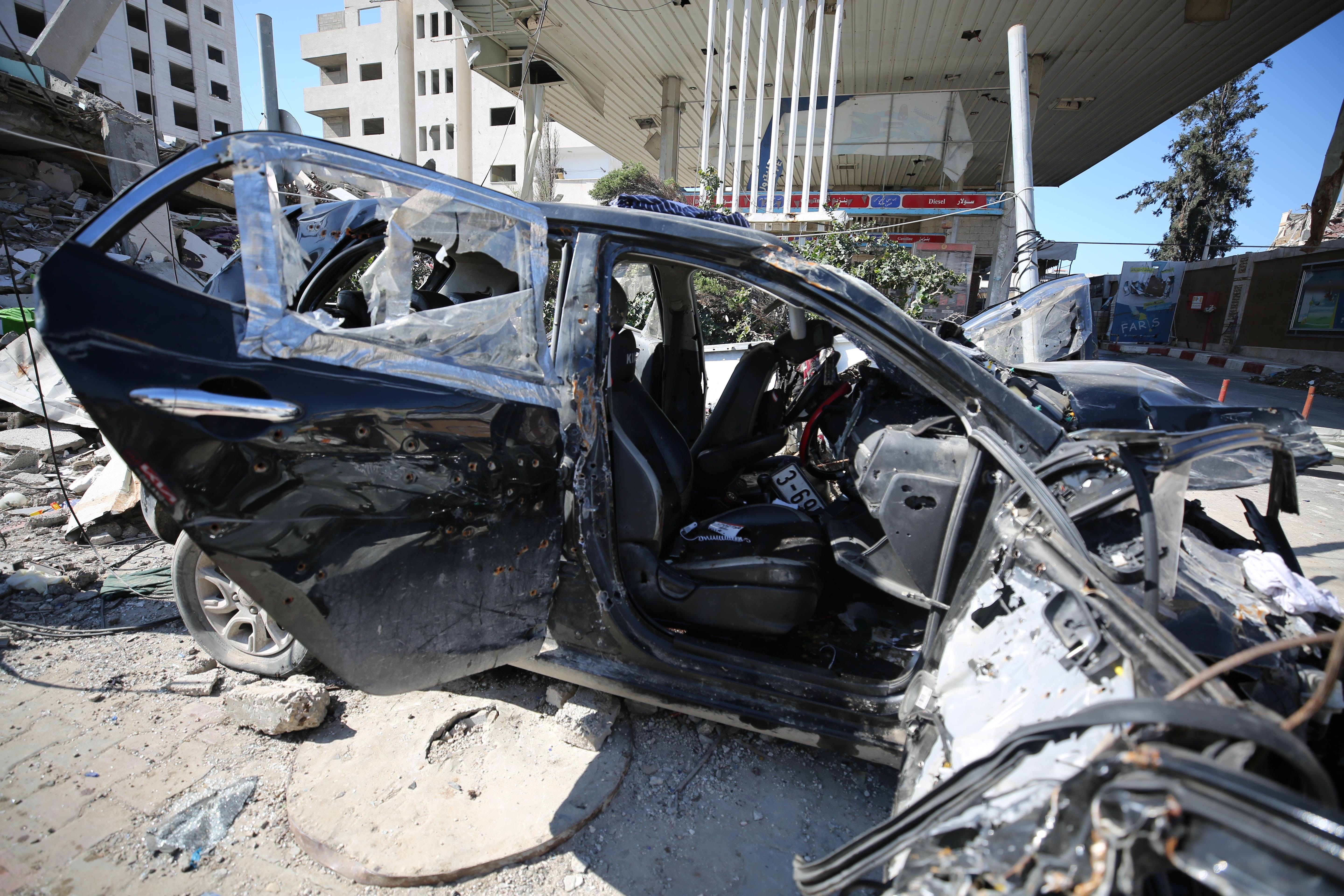
The car where Hind is sheltering is near Fares petrol station. The sun sets. Gaza City is shrouded in darkness.
“I’m scared of the dark,” Hind tells Rana.
“Is there gunfire around you?” Rana asks.
“Yes,” Hind says. “Come get me, please.”
After three hours, the IDF gives paramedics permission to rescue Hind, with a map of a route the ambulance must take.
“Hind!” Omar announces on the phone. “In one minute, the car will reach you. It’s just moving slowly.”
The ambulance’s paramedics, Ahmed al-Madhoun and Yusuf Zeino, approach the area. They get within 162 feet of the vehicle.
“Can you see the car?” a dispatcher asks.
“I can’t see a thing here,” one paramedic responds.
“Do you have your siren and flashing lights on?” the dispatcher asks.
“Just the lights, not the siren…oh there it is — ”
There is the sudden sound of gunfire and explosions.
The paramedics can no longer be reached.
Omar asks Hind if she heard an explosion. She responds that she has.
“I’m so scared, please come,” Hind repeatedly pleads.
There is a long period of silence.
“Why aren’t you speaking?” Rana asks Hind.
“I’m not speaking because my mouth is bleeding,” Hind says.
“Wipe it with your hand and then tell me if you’re still bleeding,” Rana says.
“I don’t want to get my shirt dirty, so I don’t trouble my mom,” Hind replies.
“It’s okay, wipe your mouth and I’ll wash it, my sweetheart,” Rana tells her.
“Okay,” Hind says.
Her voice fades away for the final time.
Wissam, Hind’s mother, waits anxiously at the hospital. She desperately searches every incoming ambulance for her daughter.
The Israelis seal off Tel al-Hawa. Palestinians are unable to reach the car until 12 days later. When they finally enter the area, they find the burned-out shell of the ambulance that was sent to rescue Hind.
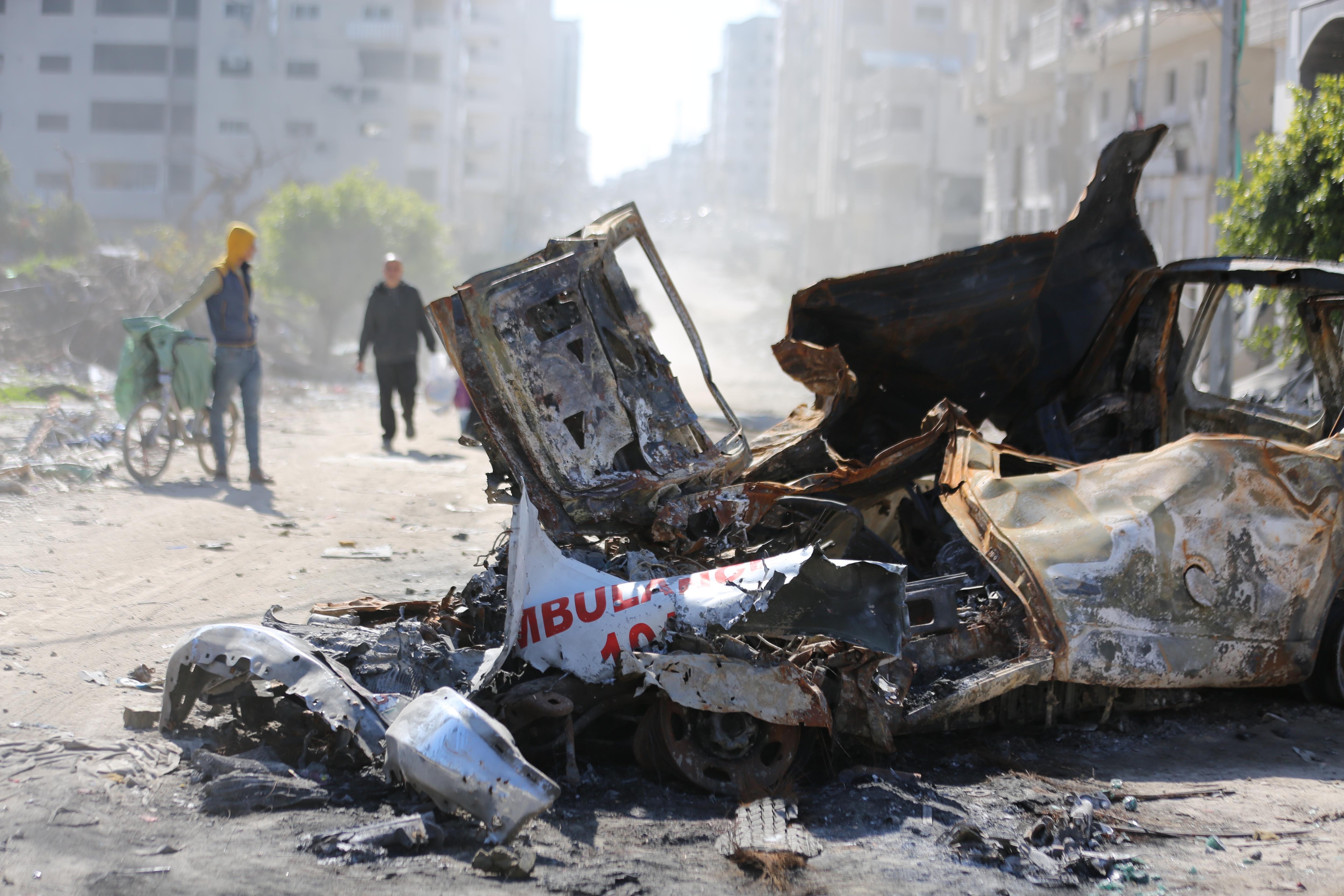
By that time, Israel has destroyed 80 ambulances, usually killing their crews.
Further up the street from the ambulance, they find Hind’s decomposed body in the back of the car with her relatives.
There are 335 bullet holes in the car and the windows are blown out.
What were Hind’s final thoughts? Did she see the flashing lights of the ambulance? Did she believe she would be rescued? Did she watch the tank shells rip apart the ambulance and see the paramedics die? Did she see the Israeli machine guns before they opened fire on her? Did she cry out in pain? Did she linger, bloodied and wounded, like her cousin Layan? Did she realize she would not be saved? Did she utter any final words, alone, in the darkness and horror?
“The Voice of Hind Rajab” reminds us that indifference is complicity. It mocks the rhetoric used to dehumanize Palestinians. It unmasks the petty and deadly tyranny of military occupation. It illustrates the powerlessness, indignity and savage violence of occupation. It exposes the fundamental nature of war and genocide. It is a testament to what is good and what is evil.
It asks us to make a choice.
This post has been syndicated from The Chris Hedges Report, where it was published under this address.