
There are people who show up for the photo, and there are people who show up for the work. Chance Meeting is the second kind, which is unfortunate for his sleep schedule and extremely fortunate for everyone else who still believes “showing up” means more than posting a rectangle online and calling it courage.
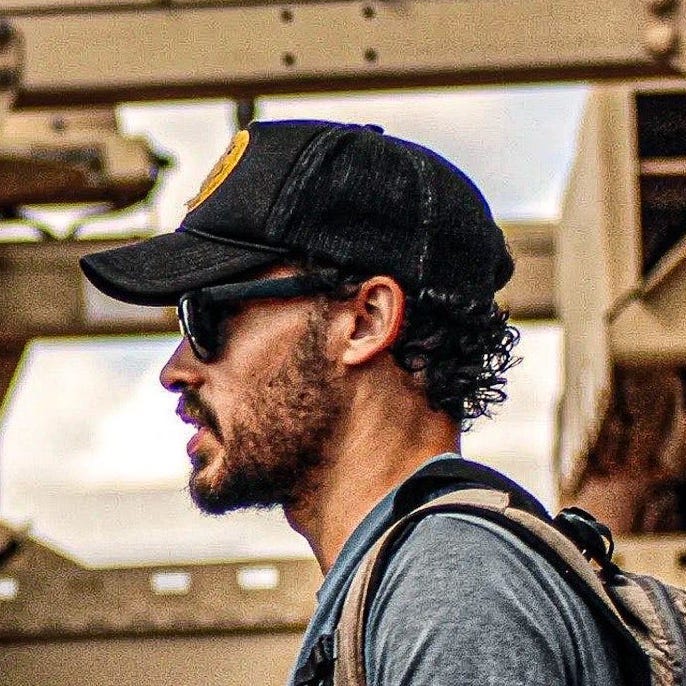
Chance didn’t drift into this story like a tourist. He drove straight into it like a man whose nervous system had decided rest was optional. While most people were arguing over headlines and vocabulary, Chance was already out there doing the only thing that matters in real time: bearing witness. Not the glamorous kind. The unphotogenic kind. The kind that happens after the chant fades and the easy narrative collapses under the weight of real faces.
Most of this year, I have been on the road with him. Not a cute “road trip.” A real one. The kind where days blur together and time is measured in receipts, gas station lighting, and which muscle group has finally mutinied. We went from “Alligator Alcatraz” Concentration Camp in Florida to Broadview Concentration Camp near Chicago, and then pressed on toward Minneapolis, with the story bleeding into the windshield every mile. Chance was there for all of it, the full relay race of grief, anger, and exhausted persistence.
Along the way, we spent two nights at My Cluck Hut, a soap factory in Nashville that smelled like lavender and solidarity. We went to Mammoth Cave in Kentucky, where we stood underground in ancient silence and felt, briefly, like the planet was telling us to breathe before shoving us back into the noise.
Chance moved through it all with a steady purpose that bordered on infuriating. Not performative. Not dramatic. He didn’t need to be the main character. He needed to get the footage right. He filmed the things most people miss because they’re not “viral”: how crowds change after the third hour, how grief settles into shoulders, how anger sharpens or softens depending on who’s standing nearby. He filmed like he was building a record, not a highlight reel.
Then Tomah, Wisconsin happened.
Black ice. The kind that looks harmless until it’s under your tires and suddenly you’re negotiating with physics instead of pretending you’re in control.
The SUV slid. We hit the side of a semi truck. Not once. Twice. Metal, momentum, and that sickening delay where your brain hasn’t caught up to what your body already knows just happened. For a brief, clarifying second, the entire plan was don’t die.
We didn’t. Somehow.
We sat there afterward with that ugly, stunned quiet that settles in when you realize how thin the line actually is.
The next morning, Chance was battling sub-zero temps in the hotel parking lot like a man refusing to accept the universe’s suggestion that we were done. Zip ties cinched tight with numb fingers. Cardboard scavenged and shaped into temporary hope. Duct tape layered with the confidence of people who understood they weren’t fixing a problem, just negotiating with it. It wasn’t pretty. It wasn’t safe. It was enough. Against all reason, it held.
And that’s how we got back on the road to Minneapolis.
By the time we arrived, the pace didn’t slow down. It got heavier. Vigils. Protests. Arrests. Teargas. The grim arithmetic of a country that keeps demanding sacrifice from the same communities and then acts surprised when those communities finally start yelling.
Chance stayed in it. He documented it. He didn’t turn suffering into content. He turned chaos into a record. That’s a rare integrity in a time when the algorithm wants everyone to be a clown.
Here’s the part nobody romanticizes: this work costs money. Gas. Food. Gear. Time. The pieces of your life you don’t get back. Chance did it without an institution, without a salary, without anyone swooping in to cover expenses and praise his bravery. He did it because it needed doing.
So if you’ve ever watched his videos and felt your stomach drop, or read his work and recognized the room, stop treating him like an on-demand resource. Follow him. Share his work. Subscribe. Donate to his BuyMeACoffee or GoFundMe if you can. Not as charity, but as infrastructure. Because when the people doing the work disappear, everyone pretends they didn’t notice.
And now, because honesty matters and friendship deserves balance, we end with cribbage.
I recently taught Chance how to play cribbage. This is a documented fact. I showed him the board, explained the pegs, walked him through counting hands, and gently introduced him to the spiritual concept of humility. And now, every once in a while, through what can only be described as statistical noise and divine mischief, Chance beats me.
When this happens, Chance develops a condition known as Big Peg Energy.
This manifests as premature celebration, unnecessary commentary, and the dangerous belief that a single lucky hand constitutes mastery of a game that has ruined friendships for centuries. Let the record show: winning a few games does not make you a cribbage god. It makes you lucky. The correct response is a quiet nod, not a victory parade.
Proper cribbage etiquette is simple. You win, you count your points, you peg with dignity, and you do not act like you’ve cracked the code to the universe. The board remembers everything. Hubris is always punished in the long run.
That said, Chance is still invited to the table. Always. Because even when he’s being insufferable about cribbage, he’s solid where it counts.
Chance Meeting is the kind of person movements survive on. Not flashy. Not performative. Just present. Again and again. If you believe in this work, help carry him the way he’s been carrying others.
This post has been syndicated from CLOSER TO THE EDGE, where it was published under this address.